

A Deep Dive into Raffaella Carrà: Her Costumes
Raffaella Carrà’s costumes made costume-design history.

1983.
In second grade, I had two daily habits right after I came out of school. The first was to stop by the window of the local record shop called “L’Angolo Della Musica” to check the latest releases on display. The second was to rush home to catch the last part of “Pronto, Raffaella?”, the daily hybrid of game show, talk show and variety hosted by Raffaella Carrà. As I was sitting two feet away from the TV screen (which was something my mom always reproached me for), along came Raffaella and a group of male dancers singing “Caliente Caliente” in black leather and bondage outfit that were a clear reference to the gay leather/Tom Of Finland style universe. My mom behind me was also fascinated by the performance and was hypnotized by such a contrast of “dark” costumes and the joyful tune Raffaella was singing. It was the beginning of my fascination with the aesthetics/music combo that just in those years was making history in Italian culture.
Disco Bambino
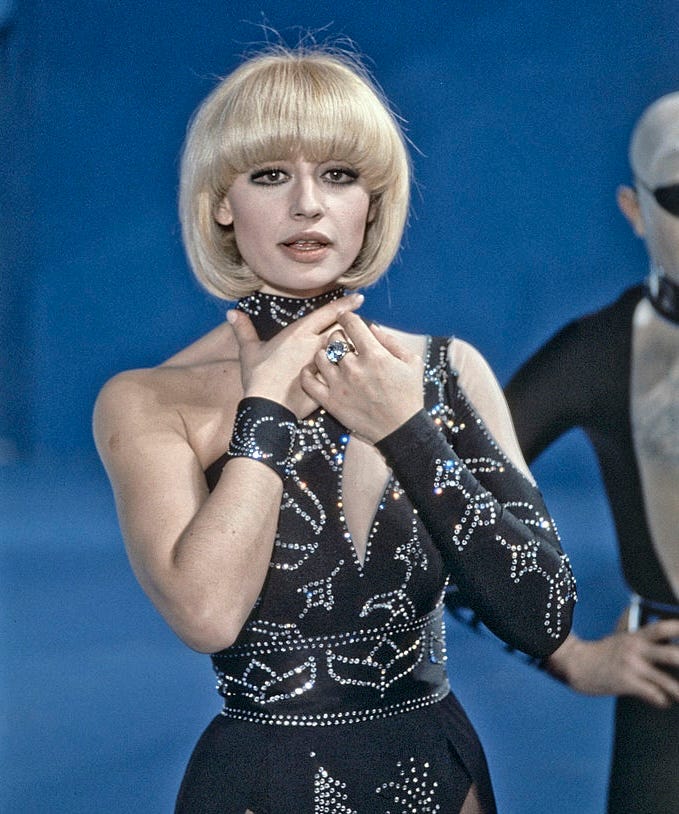
When people picture Raffaella Carrà in their mind’s eye, the first bars of a song usually go alongside a golden bob and a series of flashy, yet elegant jumpsuits, and gowns, encrusted in rhinestones or embellished with feathers. Her stage persona was never limited to her music: a consummate dancer with a full grasp on the importance of visual culture, she fashioned herself as a total work of art. Read our analysis of Raffaella Carrà's music in case you missed it.
Costumes are crucial in the definition of an image of a performer or a character, and this is especially true among Italian singers, performers and divas, as they harnessed TV as a way to reach the widest audience possible. Costumes made for variety shows–so where a performer is “playing themselves” and not a character in a fictional context–have to make the performer or the diva instantly recognizable: after more than 50 years, Carrà’s statement jumpsuits and her bobs are seared in the collective imagery as much as, say, Cinderella’s ball gown, Dorothy’s pinafore, and Lady Gaga’s earlier, more daring looks.
In the case of Raffaella Carrà, Raffaella herself saw her as another version of herself, referring to it as “the Carrà character.” Her everyday self, Raffaella Pelloni, was a quiet, introverted, and private person. With that being said, Carrà’s performances, in particular, heavily relied on choreographies where she was surrounded by a host of muscular male dancers: the presence of sequins, rhinestones, and voluminous sleeves (or pants) would heighten the choreographic component of her performance within variety shows. Similarly, when a costume designer chose to emphasize her legs with semi-sheer tights or spandex leggings, her agility and flexibility would take the spotlight.
On that note, Carrà often spoke about how she would feel fully at ease in full high-camp regalia but would feel self conscious if she were made to wear a traditional two-piece suit. “Luca, if you give me a pair of golden tights, I can leave my house,” she told costume designer and long-time creative collaborator Luca Sabatelli. “But if you make me wear something that’s heavy on tailoring, I will look like a secretary.”
Ever since RAI’s inception, TV and fashion had been inextricably linked: coverage of fashion shows started as early as 1959, and some of the most reputable ateliers, such as Sorelle Fontana, would use the Sanremo music festival to showcase their latest creations on female performers. On January 9, 1959, the tv special titled “La moda dell’estate” showcased the latest fashions alongside music entertainment. The director was none other than Enzo Trapani, who would then become one of the most eminent visionaries in variety television. This relationship between national tv, fashion and stagecraft sets Italy apart from its neighboring countries, and the costuming of Italian disco divas is a testimony to that.


The Midriff That Started It All: Enrico Rufini’s Costumes
Early in her career, when she co-hosted the variety show Canzonissima in 1970, Raffaella Carrà made fashion and costume-design history by appearing on national tv with a bare midriff. The outfit in question was a white, two-piece set consisting of flared pants, and a mock-neck crop top with sheer, tulle sleeves with satin ribbons tied along her arms. There is also a black version of this outfit, which replaces the pants with a miniskirt and has the ribbons also connecting said skirt with the matching crop top.
These two outfits were trailblazers: Cher would only follow suit in 1971 in Sonny and Cher’s Comedy Hour, while encountering pushback from tv execs, and then on The Cher Show.
