The True Key to Amanda Lear's "Enigma"
How Amanda Lear became both the canvas and the toolbox for her own self mythology
It’s quite rare for a premium American channel or streaming platform to devote much thought or care to Euro music acts—unless they want to poke fun at them or conduct some well-meaning but often tone-deaf ethnography. So when HBO announced it had acquired Zackary Drucker’s Enigma, which premiered in 2025 at the Sundance Film Festival, our interest was piqued.
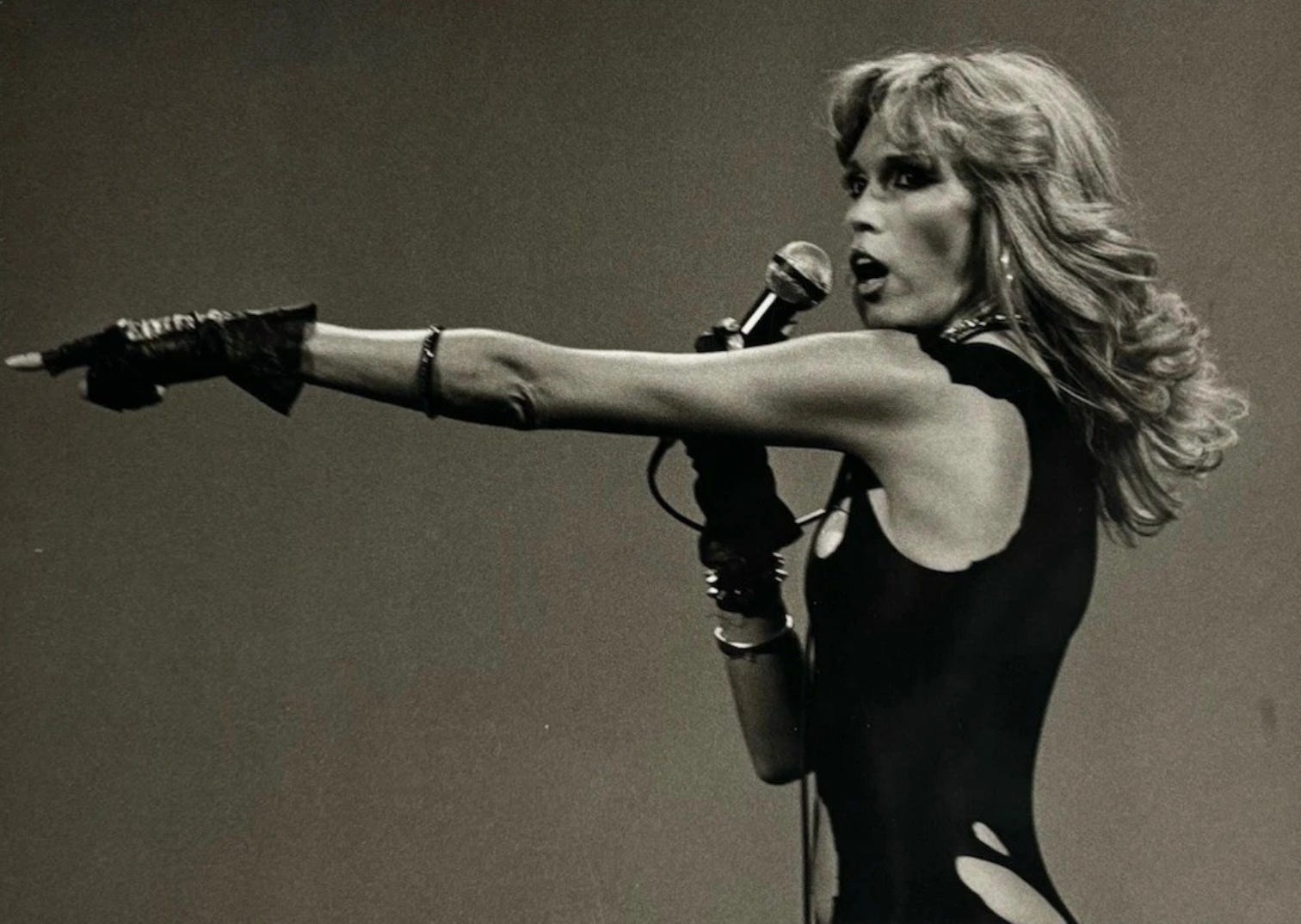
Ever since Salvador Dalí allegedly fashioned a young Amanda Lear into his muse with the words, “It’s always been the Grecian ideal: the hermaphrodite, the divine being […] You’re neither a girl, nor a boy. You’re angelic, an archetype,” Lear’s presentation and gender identity have intrigued audiences almost as much as her unique recipe of Euro disco. And her music style was nothing short of unique: she might not have had the widest vocal range, but combining lush melodies and instrumentations—both acoustic and electronic, if need be—with recitativo-like vocals created what is undoubtedly the “Lear Sound.”
Filmmaker, producer, actress, and LGBTQ+ activist Zackary Drucker approaches the broader context of the subject with skill, thoroughness, and excellent reporting chops. That is clear in the meticulous research and reporting she conducted with the older trans women who provide both anecdotes and context. The table setting in the Enigma documentary is hopeful and downright dreamy. Performers and entertainers such as Bambi and Dolly van Doll relate the way 1950s Paris and the cabaret scene provided a stage and a platform for trans women from all walks of life. Thanks to clubs like Le Carousel and Madame Arthur, entertainers might have had rivalries and spats, but they often became each other’s chosen family and kin—for example, star performer Coccinelle told them what hormones to get to fully affirm their gender with their appearance. On top of that, Bambi recalls how eventually, the community grew to a point where supply exceeded the demands of Madame Arthur and Le Carousel, so they had to do whatever it took to get by. “Everyone at the Carousel knew how close they lived to the line and how, with one false move, they could be walking the street turning tricks for penny,” writer, artist, and historian Morgan M. Page tells Drucker. Indeed, the freedom and artistic expression they could exercise while at the cabaret did not match the prissy “public decency” laws, and Drucker lays it all out with thoroughness and respect. Page also added that any hope for a non-demi-monde life hinged on being able to afford a ticket to Casablanca to get gender-affirming surgery, after which one could start a new chapter of their life. Honestly, we could have watched a documentary about mid-century trans cabaret stars in Paris for hours.
However, Enigma then devolves into a game of cognitive dissonance and unreliable narration. April Ashley, who passed away in 2021 and whose narrative segments anchor the recount, reminisces about a newcomer who went by “Peki,” an art student who would sketch patrons at a restaurant when in between gigs, and whom Ashley took under her wing. While Peki appeared to struggle to find their footing as a performer in the beginning of their career in the mid-1950s, they eventually gained mainstream recognition as a model in London after a stint in leather-based acts.
This documentary asserts that Peki is Amanda Lear’s old self, and shows a lot of scans and B-roll footage of tabloids, especially Italian ones, speculating on Lear’s biological anatomy. The direct exchanges on the matter between Lear herself and Drucker behind the camera can cause either rubbernecking or moderate to severe discomfort. Lear kept denying knowing April Ashley and claimed she never heard of Peki; meanwhile, Drucker—a trans woman who had been looking up to Lear as a muse and a paradigm for decades—tried to make her formally come out. It felt like an interrogation trying to extort a confession under the guise of allowed vulnerability. We do not have the lived experience to determine whether it’s healing or invasive to pry into Lear for some sort of kinship (but would love to hear from any readers who could share any insights on the matter), but alleged transvestigation aside, the final cut of this documentary is symptomatic of us being uncomfortable with art and artifice in the name of relatability and vulnerability.
In a statement to The Washington Post after an alleged cease-and-desist sent by Lear to HBO and the backup documentation provided by Drucker’s team to prove that she was aware of the line of questions that would be asked, Drucker shared her intent: to “honor Amanda in all of her expressions, and the fullness of her greatest work of art: herself.”
One can reframe the enigma of Amanda Lear as a reflection on self-construction: “Why do you have to accept your destiny if you can make it better?” Lear wonders in the documentary. “You’re fully free to change your destiny.”
Amanda Lear the performer both produced works of art (musical and visual) and is, indeed, a work of art. “It’s not about being famous,” she tells Drucker. “It’s about being special, I think.” If you pay a modicum of attention to her lyrics, she fully lays out her artist’s statement.
The meta-commentary present in her songs clearly alludes to the myth of self-creation. In “I am a photograph,” a single from the debut album of the same name, she asserts:
“You can look at me for hours / I won’t mind, I’ll let you dream / From the page of a magazine [...] But cameras always erase / Fear lurking behind a face / I am a lie and I am gold / But I shall never grow old [...] Maybe I’m just a piece of paper / But some think that I am better / Cause photographs do not complain.”
In “Miroir” from Never Trust a Pretty Face, she sings from the point of view of a blow-up doll, telling the addressee of the song, “Mais toi tu n’es qu’humain, tant pis pour toi.” Her persona, on the other hand, being made of synthetic material, won’t have her lips chapped by inclement weather nor will it be bothered by the blazing sun. The closing is a deadpan condemnation: “Les miroirs ne font pas tant d’histoires / Ils reflètent sans réfléchir / Insensibles à ton désespoir” (mirrors don’t make a huge fuss; they reflect without reflecting, insensitive to your despair).
In “Fabulous,” a single from Diamonds for Breakfast, she sings a carpe diem of sorts, beckoning her lover to focus on the present but hinting at her own metamorphoses: “nobody could tell / That I once was somebody else”; “And when you look into my life / You’re gonna see the reason why / I’m gonna leave it all behind”; “I’ll answer your question with contradiction / I’ll give you my fabulous love / I seem so transparent / I move like a serpent / My fabulous secret is mine.”
Sweet Revenge, the album that contains what is a Faustian-myth suite, also has a track aptly titled “Enigma.” In it, she turns the paradigm around as she is faced with falling for someone she cannot fully pin down: “Are you devil or angel? Are you question or answer? For me, you are an enigma, for me, you are really a mystery... A mystery, a mystery, a mystery.”
In 1986, she would sing the Hi-NRG track “I am a mystery”: “Am I real or am I an illusion? Who can say? I am from another world.”
In addition to the meta-commentary on her persona and personhood, the numerous chthonian and mythical beings that inhabit her musical universe are also indicative of Amanda Lear the work of art. Her songs are populated by femmes fatales (“Lady in Black”), goddess-like ladies of the underworld (“the opium queen / Babyface girl from Shanghai never smiled and never cried / She now rules the underworld down in Chinatown”), and even creatures that are not fully human.
The most emblematic example of this is “The Sphinx” from Never Trust a Pretty Face. In a setting that’s halfway between biblical, metaphysical, and surrealist, Lear as the titular Sphinx talks about how “I keep looking for all the faces [she] had / Before the world began.” In the refrain, she states emphatically: “I don’t want any past / Only want things which cannot last.” One can wonder if this song is in dialogue with Oscar Wilde’s The Sphinx, where the mythical creature pays visit to a man and is thoroughly interrogated by him on her past, only to be reviled (the narrator of that poem then resorts to praying to Christ): both sphinxes have seen it all and have borne witness to the tides of history. Lear’s music is, too, a testimony and key artifact of a bountiful artistic period and also an active player in the field.
Of course, in “Follow Me,” perhaps her most notable track across demographics, the theme of “supernatural beings” and “identity as artifice” coalesce. The narrator of the song, a version of the Faustian Devil, is able to sell “dreams, new desires” and can “trade hopes.”
“Unbelievable maybe / You′ll have a new identity / For a second of vanity / I want to change your destiny”
So where does all of this leave us? On Facebook, in the wild, I found this insightful comment: “Amanda Lear remains a creation. When Amanda was made, she was made a woman. Amanda did not transition. Amanda is of female gender.” Whether there was indeed an old self, or “the person before Amanda transitioned, but Amanda did not transition,” that’s a moot point. Given the rich, multi-layered lyrics of her enormous repertoire, Lear’s gender is less interesting than the self-mythology and the world-building she created across her career.