Disco Bambino Presents:"Dancing Without You."
feat. the vocals of Sophie Ellis-Bextor and Nile Rodgers’ guitar.
June 26 marks the release of “Dancing Without You,” Disco Bambino’s original composition featuring the vocals of Sophie Ellis-Bextor and the guitars of disco titan Nile Rodgers.
The track has a lush orchestration, an opening monologue in Italian about theater and stage lights, and Sophie Ellis-Bextor’s “character” dancing on her own. And while, despite the dominating 1970s soundscapes, the first verse has some ’80s synth-pop and ’90s dance hints (the phrase “You’re so long gone but you’re in my heart” can make you think, melodically, of “You’re My Heart, You’re My Soul” and “Desperately Seeking Someone Willing to Travel”), the rest has the lush opulence of a late-1970s disco hit with some Broadway (or West End) theatricality. When the beat picks up in the pre-chorus and Ellis-Bextor sings, “put on my makeup, a fashionable fool, mascara running when I think of you,” you’ll hear the assertiveness of an “I Want” musical number; the phrase “they shine / like diamonds when I move” presents some light operatic vocal flourishes.
The refrain is pure 1970s disco: think Saturday Night Fever with a lovelorn diva instead of failson Tony Manero. The overall mood carries the assertiveness of “I Will Survive” and “Strong Enough” with the anthemic gravitas of “Your Disco Needs You” and “Life Is a Cabaret.” Nile Rodgers’ guitar adds a layer of grit that legitimizes the disco component of the track.
Sophie Ellis-Bextor is a natural fit for a disco-inflected track. “Groovejet” was disco music filtered through ’90s Eurodance and house beats, and she covered Cher’s “Take Me Home,” Alcazar’s “Crying at the Discoteque,” and Raf’s “Self Control” in a way that made them entirely her own, with her vocal timbre conjuring the idea of a cosmic, yet not distant, siren.
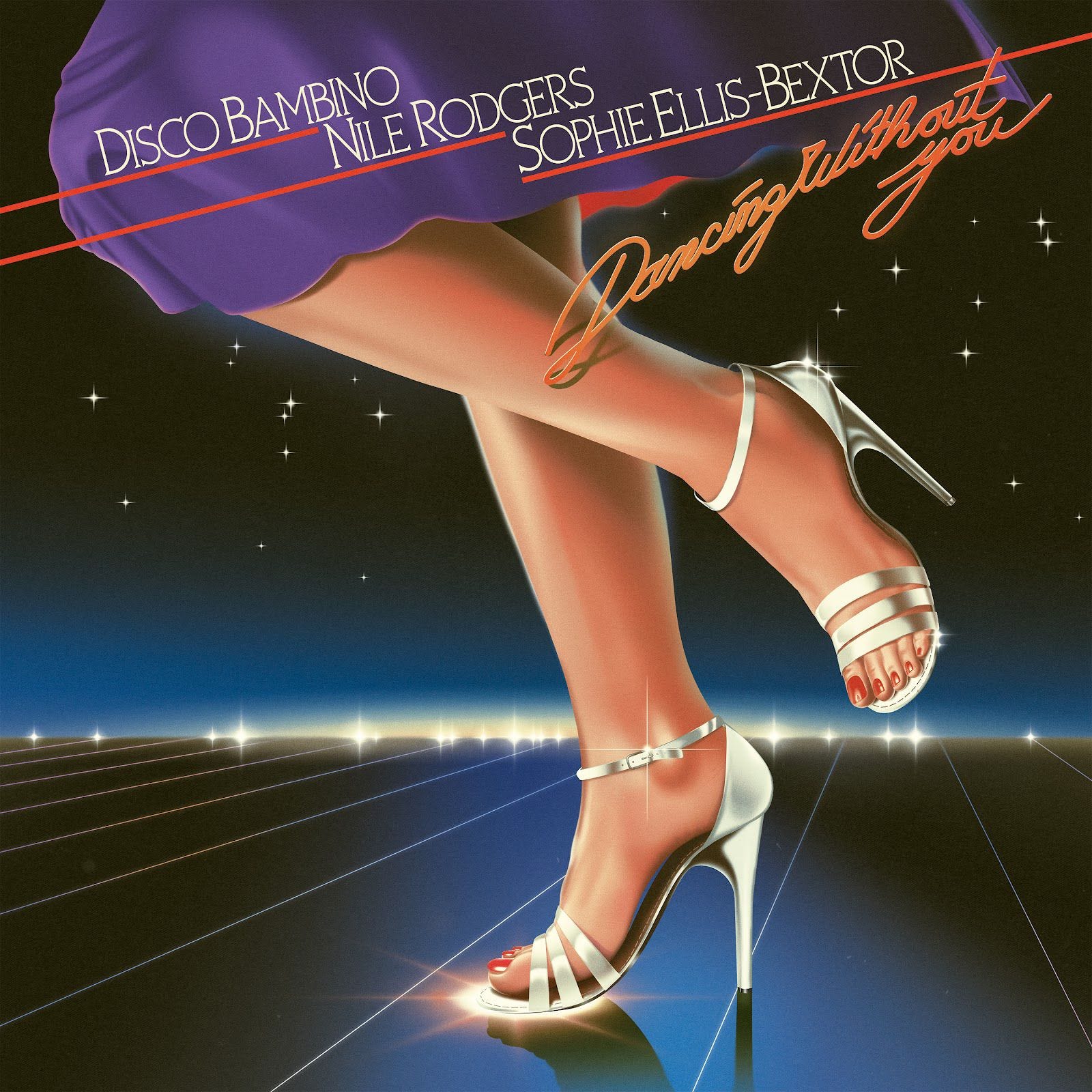
The cover, art-directed by Giuseppe Giammetta and illustrated by artist Sandro Rybak, makes all these influences coalesce: the feet are not stomping on a dance floor, but on what looks like a theater stage; the color palette is quintessentially late-1970s, but the fashion could be placed anywhere between the 1950s and now. Rybak’s art style is both pictorial and retro-futuristic, which fits the melody and the vocals of the track.
Below, Angelica Frey asked Disco Bambino to break down the creative process. The interview has been edited and condensed.
This song is disco, but not of the upbeat, bubblegum variety
I’ve always been fascinated by so-called disco music with nostalgic, melancholic, and sad tones—those darker shades compared to the kind of disco music you hear at weddings. That’s because I’ve always seen the dance floor as a small universe, a universe where you can feel many different emotions, from euphoria to sadness and reflection. So this kind of disco music, with its slightly gray tones, has always inspired me.
It’s not italodisco
What emerged was a piece that is quintessentially disco, sans Italo: we wanted to create a bridge between Italian and international disco. People are defining it as “eurodisco,” and I like it. It’s made in Italy, but with a more international berth.
“Dancing Without You” is centered on two distinct, yet related, images.
The first core image is the world of variety shows that I watched when I was very young—different editions of Fantastico, Tilt—with their strong sense of theatricality in both performance and staging.
Then I remember that, as a child, after those shows ended and the credits rolled, films about love stories—often tragic and sad—would follow. Hence, that tension between those two moments, which I experienced on those Saturday nights with my family, became the basis for this melancholic melody that makes me think of heartbreak.
Nile Rodgers provided the guitar track.
Following the end of my contract with my label, I worked on various demos with Tim Powell, the producer who handled the production of this track. After I had put together three or four songs, I called Nile Rodgers. We’ve known each other for 15 years—we had done several events together for the We Are Family Foundation, and over time we obviously became great friends, united by this shared passion for disco. For me, he has always been a legend. At five years old, I was dancing to “Le Freak.”
His presence in my life, even on a personal level, has always been a great blessing from the universe. We care deeply about each other, and he always told me, “Whenever you want to make a song, let me hear it, and if I like it, I’ll put my guitars on it.” And that’s exactly what happened. When I finished the song in London, Nile chose the melody of “Dancing Without You” as the one he wanted to record. “...As soon as I have a minute, I’ll record the guitar tracks for you,” he said.
Well, those months for him were rife with gigs and other commitments, but around Christmas he had taken a break on an island. While we were exchanging messages, Nile told me, “I’ll find a recording studio on the island and record the guitars for you.” He worked his magic: he found a recording studio and recorded his guitar track.
The demo needed the right artist.
After the demo, some time went by, and we were struggling to find the right recording artist. We had a few options, but the initial artists we selected did not connect with the melody—it happens. A few months later, thanks to a mutual friend, we went to see Sophie Ellis-Bextor in New York. When she appeared onstage, I saw her emanate this gorgeous, theatrical energy that reminded me of our beloved 1970s Italian varieté divas. We ended up following each other on IG, and so I sent her the demo.
Sophie Ellis-Bextor instinctively “saw” Disco Bambino’s images.
She fell in love with the melody; it spoke to her as her own. She decided she’d write lyrics and perform the song. Without me giving her a single input or background info, she managed to extract the essence of this melody. She wrote about a diva onstage, standing under the limelight, adored by the crowds and living a seemingly perfect life, but carrying the pain of heartbreak within.
The way Sophie wrote it is gorgeous: heartbreak is worn like a couture gown, tears are like sequins that shine like diamonds. So she managed to come full circle: in her words, I saw Raffaella Carrà and Stefania Rotolo. Sophie conjured the complex brilliance, both artistic and figurative of women —think of Raffaella Carrà, Stefania Rotolo, Nadia Cassini, and Loredana Bertè— who, despite being lauded and adored, were carrying a lot of heaviness and grief.