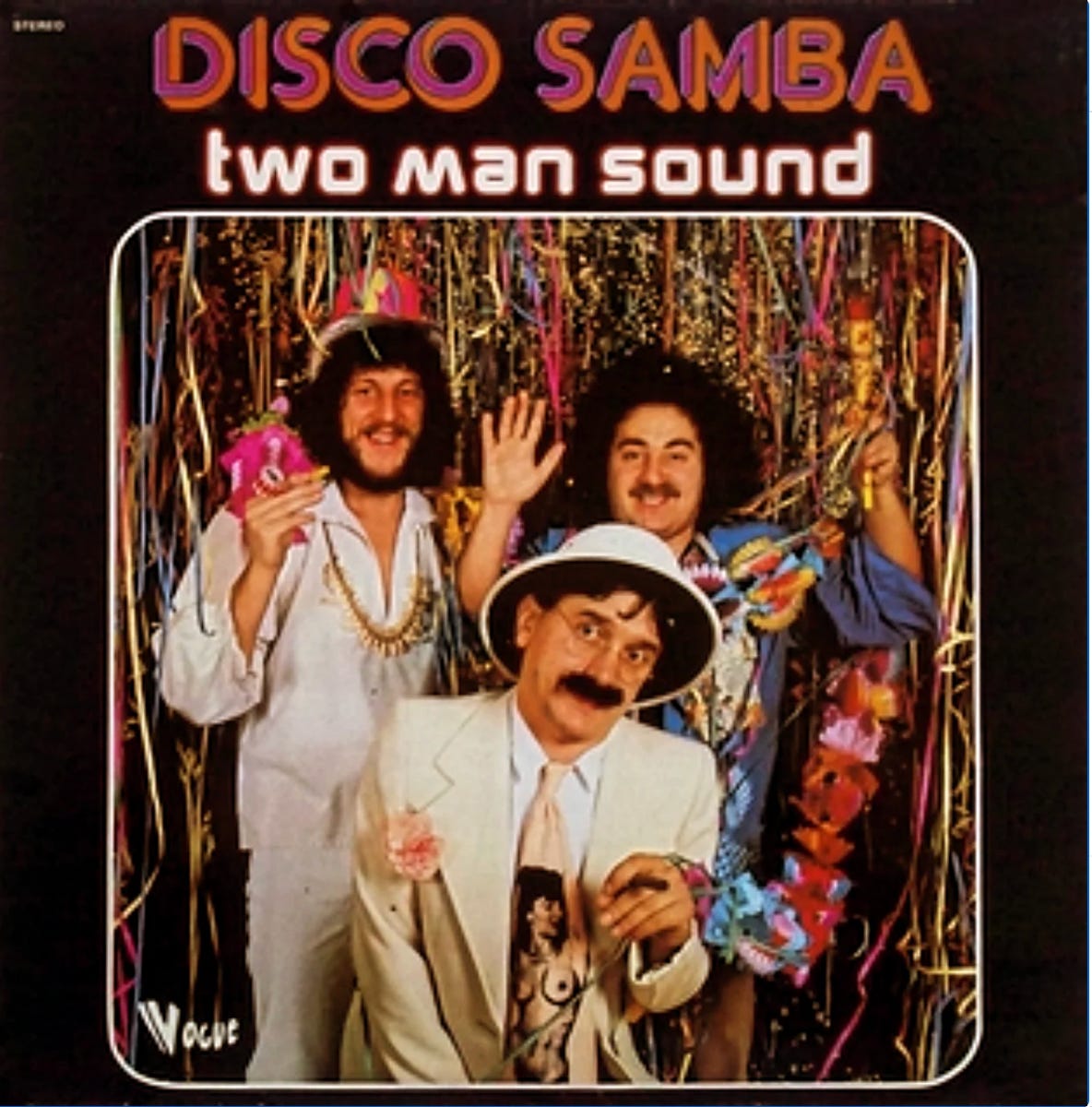
Brazilian Standards + Belgian Disco = Italy’s Ultimate New Year’s Hit
On "Disco Samba" by Two Man Sound
Sing, or approximate, “pe pe pepepepe”, “A E I O U YPSILON”, or “Brigitta Bardot, Bardot” to any Italian, and chances are they will closely associate it with a debauched, yet wholesome, New Year’s celebration.
While these are excerpts from Brazilian standards, it’s mostly thanks to a Belgian band that they entered the Italian (and European) pop-cultural vernacular. Enter “Disco Samba” by Two Man Sound, released in 1977.
Originally a Belgian pop trio, Two Man Sound became famous all over Europe for giving Brazilian standards a Euro-disco spin.
Lou Deprijck, Yvan Lacomblez, and Sylvain Vanholme sought to stave off the gloomy European winter by conjuring a warmer, and more welcoming, atmosphere via a combination of disco, schlager, and, yes, songs that are part of the Brazilian tradition. They famously released a cover of “Charlie Brown” in 1976, and, relatedly, Deprijck and Lacomblez also penned “Ça plane pour moi” by Plastic Bertrand.
“Disco Samba” is a medley that includes standards such as “Tristeza” by Jair Rodrigues, “Zazueira” by Jorge Ben Jor, and “Brigitte Bardot” by Jorge Veiga. It’s not merely a collage, though. The kitschy and catchy intro, which combines percussion and quintessentially disco strings, is Lou Deprijck’s creation, as is the interlude “So Fla Fla”.
Somehow, it gained traction during occasions such as office parties, house parties, and end-of-year celebrations across locations. It was very conducive to the Conga Line, which, unlike line-dancing choreographies, has no set sequence of steps and requires no coordination and thus has a very low barrier of entry.
Italian radio Radio Deejay equates it with, potentially, setting the likes of Italian standards “O Sole Mio”, “C’è la luna,” “O mia bella Madunina”, and “Romagna Mia” to the same 4/4 bass line—honestly, it could work, potentially.
Ultimately, “Disco Samba” is one of the 1970s hits that helped popularize the juxtaposition of “continental” atmospheres and arrangements and Latin-American/Spanish-inflected melodies. On the original-songs front, we saw it in Germany with Rex Gildo and his “Fiesta Mexicana” (1972); with ABBA courtesy of “Fernando” (1976) and “Chiquitita” (1979); with Raffaella Carrà thanks to “Fiesta” (1977) and “Pedro” (1980); with Lu Colombo and “Maracaibo” (1981); the German girl-group Arabesque sang of a dashing “Caballero” in 1982; in Spain, the Eurodisco duo Baccara did the opposite, leaning fully into disco Schlager with “Yes Sir, I Can Boogie” (1977) and “Parlez-Vous Français” (1978) and the Latin-American-inspired Schlager anthem “The Devil Sent You to Lorado / El Diablo Te Mando A Laredo” (1978). In the late 1990s, the trend continued with Los Umbrellos from Denmark and their one-hit-wonder album Flamenco Funk (1997), the Italian duo Paola e Chiara with “Vamos a bailar” from 2000 and “Viva l’amor” from 2001 and, to a lesser extent, the Swedish Domenicer with “Dolce Marmellata” (2000).
Put all these songs together, and you have a Pan-European New Year’s Eve or Après-Ski megamix.
In Italy, this song has the same cultural resonance as “Tanti Auguri” by Raffaella Carrà, “Maracaibo” by Lu Colombo, and even “YMCA” by Village People. We know for a fact that it’s popular all over Europe, so I would love for our non-Italian readers to share the way this song is embraced in their countries: ideally, people from the Balkans, DACH, Scandinavia, the Baltics, Central Europe, Eastern Europe, France, Spain, Portugal, and anyone we might have forgotten, because it’s 44 countries after all, should all come forward.
Happy New Year!