Inside Fiorucci’s Multi-Sensory Revolution
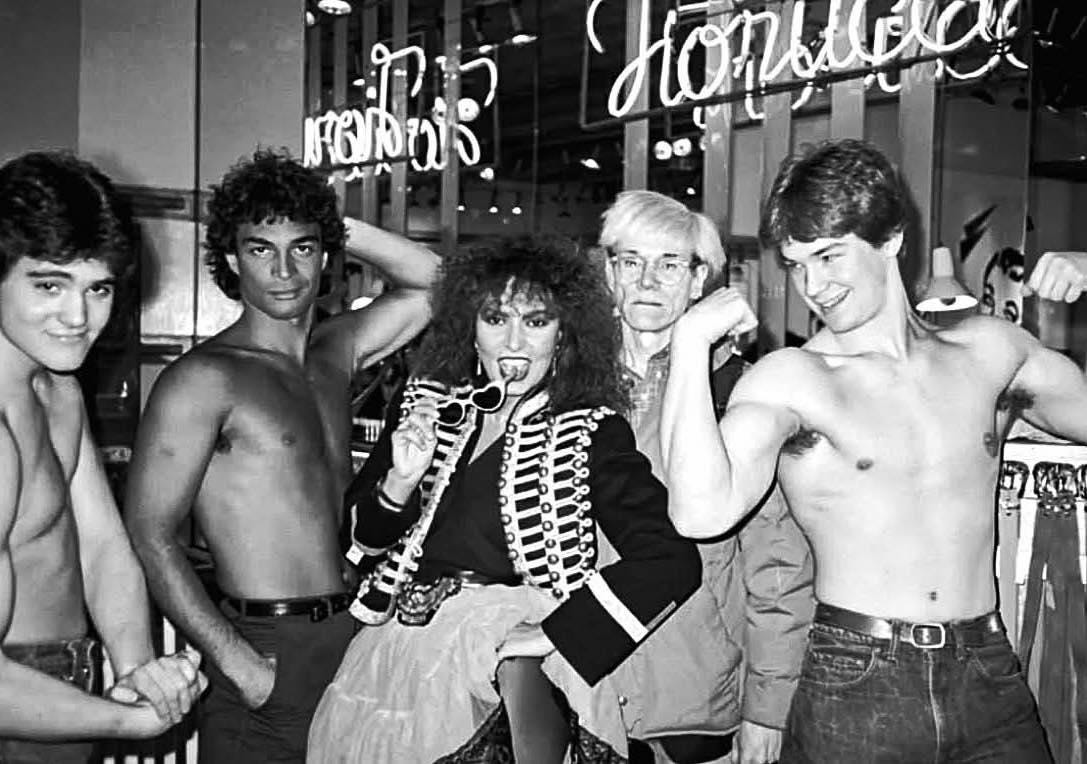
Tracing the lineage of Elio Fiorucci’s cultural epicenter, where Keith Haring painted the walls, Loredana Bertè was the main brand ambassador, and a young Madonna found her first stage.
On the 20th of February 2026, during London Fashion Week, Fiorucci staged an immersive presentation titled “Memorie,” in the guise of an intimate gathering “suspended,” per the show notes, “in an undefined era.” The set is an apartment in an undefined moment in time: it’s both vintage-inspired and retro-futuristic, slightly reminiscent of Metaphysical art, with clothes referencing various decades. Those who love David Lynch’s worlds will find themselves at ease: his heavy red stage curtains are now seaglass-colored; his signature chevron pattern is a Dalmatian print. Instead of Julee Cruise, you hear Nada’s “Ma che freddo fa,” Patty Pravo’s “La Bambola,” and Iván’s “Fotonovela.”
Fiorucci is the eponymous fashion label/concept store/total work of art founded by designer Elio Fiorucci in 1967, and central to its world were music and its clubbing component. “I must say that my fashion line and my brand as a whole have always been accompanied by music,” Elio Fiorucci said in a 2010 interview. “I even sold the records I bought in London—they were the Top Ten, which didn’t exist at the time—the free radios for which I carried record cases; and together with the clothes in San Babila, we also sold books and records.”
As early as 1975, graphic historian and Fiorucci curator Maurizio Turchet and longtime collaborator and friend Franca Soncini organized a series of experimental music performances in their Via Torino location, featuring Demetrio Stratos, Zaj, and Franco Battiato.
The San Babila location became a cultural, lifestyle, and hedonistic epicenter for 1980s Milan, de facto placing the city in the same orbit as London, New York, and Paris regarding avant-garde innovation in fashion. “It was a unique place, where you could find anything youth culture had been producing and putting out in those years, in terms of music, images, and myth-making,” writes historian Maria Canella in “Rivoluzione Fiorucci,” which appeared in the book Non solo piombo: Politica e cultura nella Milano degli anni 70 . “That’s how the idea of fashion as spectacle was born in Italy, and with it, all the implications in terms of diversifying consumer-culture patterns in vast social strata.”
In 1982, Alessandro Mendini and, to a greater extent, Alessandro Guerriero from Studio Alchimia fashioned “Arredo Visivo,” an experimental performance on the aesthetic relationship between apparel and decor. Indeed, we have to thank Studio Alchimia (remember their work with Matia Bazar?) for the design and creation of the interior-design system and key elements for Fiorucci stores. Think: the totem-shaped object known as Grande Metafisico which allowed the store to showcase footwear by the registers, and Struttura Rotante, a compass made of lacquered wood and metal.
In 1983, the Italo disco group Gruppo Italiano appeared as a “living shop window” to present their record Tropicana.

That same year, Fiorucci invited Keith Haring to make art within and for his Milan store—an offer which the latter accepted, having been strongly urged by Andy Warhol. “I was lucky enough to meet Keith Haring at the Factory with Andy Warhol. Andy Warhol said to him, ‘Go, go, because if Fiorucci makes you do something, Fiorucci is a guy who does very special things; it’s worth it,’” Fiorucci said. “Then he arrived, and I must say in the span of two days and two nights, he completely transformed the store.”
Singer Loredana Berté, who was friends with Fiorucci and who also got acquainted with Andy Warhol, became Fiorucci’s testimonial and brand ambassador around the world, especially between Milan and New York. The press conference for the presentation of her first album took place in Milan, right in the Fiorucci offices in the Galleria Passerella. “Elio had plastered the windows with my posters and gave everyone an amazing beach bag with a t-shirt and my album inside … I will never forget fans, journalists and record companies who were fighting for one,” she said in a 2021 interview.
In the United States, Fiorucci was synonymous with disco and club culture. “I remember Studio 54, which we had sponsored for the opening, because we had already opened our New York store in 1976,” he said in the aforementioned 2010 interview. “We had opened this huge shop, where at some point Andy Warhol had arrived, and where I had met all the great artists of the moment, because the shop had become, if you will, a kind of meeting point of modern American culture. It was a meeting point among all the free people in the world who could express themselves there.” Cabaret star and performance artist Joey Arias was its lead salesperson and performance lead, and featured artists in the windows included Klaus Nomi.
In terms of more mainstream music culture, in 1979 disco titans Sister Sledge mentioned Fiorucci alongside Gucci and Halston in their disco hit “He’s the Greatest Dancer,” something that producer Nile Rodgers identified as perhaps first occurrence of the brand namedropping in songs, while the music video for ELO’s “All Over the World,” written for the seminal 1980s musical comedy Xanadu, took place inside Fiorucci’s Beverly Hills location.
In 1982, Fiorucci met a young Madonna who, lest we forget, got her start dancing for the French disco act Patrick Hernandez. “Her younger brother [Christopher] worked in the Fiorucci store in New York, and she told me that she was DJing and that she would have liked to sing,” he recalled. In 1983, the Fiorucci brand turned 15. “We asked her to do her first concert—if she wanted to try singing—at Studio 54. She accepted, and we were lucky, because we can say that we gave Madonna the opportunity to do her first concert at Studio 54.”


I would never imagine a Stratos in the Fiorucci realm; rather the opposite for the polyhedric Battiato!
still such an inspiring vision, thanks for this