


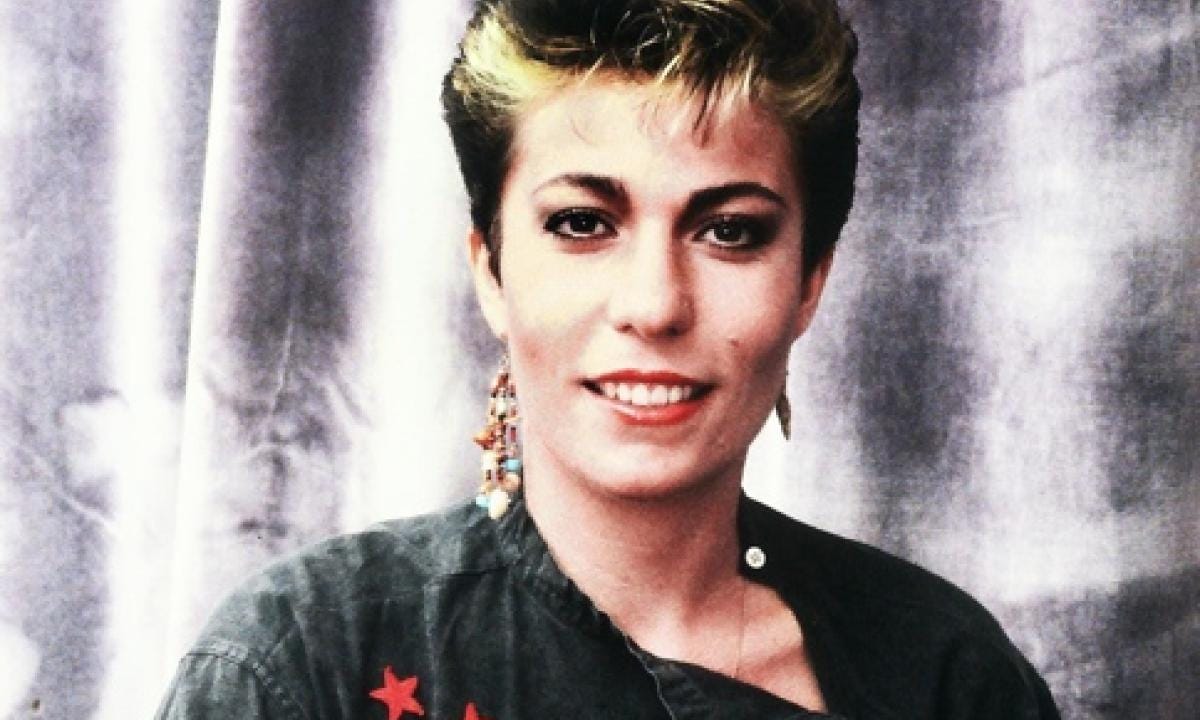
Let’s continue our journey through Giuni Russo’s discography—thank you, by the way for the love and appreciation you showed for Part I .
Also, allow us to apologize for forgetting to mention Bianca Pitzorno’s biography of Giuni Russo Giuni Russo: da un’estate al mare al Carmelo as one of the main sources for the more biographical facts behind the albums and the songs. Pitzorno wrote it in collaboration with Maria Antonietta Sisini and also hosted a contribution by Franco Battiato so it’s a version of Giuni Russo’s life that is fully endorsed by the people who were close to her both on a personal and artistic level.
The next three albums continue to outline Giuni Russo’s artistic pursuits, between synth-inflected ballads, meditations on desire, and experimentations with summer hits.
While working on these albums, both Giuni and Maria Antonietta Sisini started exploring their faith and spirituality in a more scholarly fashion: in 1986, they visited Palestine, on a pilgrimage to the locations described in the Gospels, and, in parallel to deepening their Catholic faith (also via the texts of San Giovanni della Croce and Santa Teresa d’Avila), they also started reading Rudolf Steiner and the Emerald tablets by Hermes Trismegistus. Themes of mysticism and spirituality would become prominent in their 1990s demos and tracks (so stay tuned for Part III).
Giuni (1986)
This self-titled album marks the return to the ethos and sound of Energie. Giuni wanted to break off the contract with CGD, but Caselli would stonewall her, refusing to let her go only to then deny her face-to-face meetings. Eventually, she managed to break free from her contract, but she was basically ostracized from all Milan-based record labels. In Rome, however, Carlo Bixio from Bubble Records gave her a platform
The opening track “Alghero” started because of the frequent travels to Sisini’s mother’s deathbed, where she’d commute daily between Alghero and Rome, and the refrain echoes, from a melodic standpoint, “Limonata Cha Cha Cha”. It’s a cheeky song about, for lack of a better term, a woman “feeling herself” and yearning for the Sardinian city of Alghero, with the refrain famously featuring the rhyme between Alghero and “straniero” (foreigner). This is a summer-themed song, which, in Giuni Russo’s universe, automatically translated into an instant hit.
“I Ragazzi del sole” is made of sensuous ballads about queer longing, zeroing in on twinks dubbed “the boys of the sun”: a ballad topline with electronic accompaniment and a brass solo. “Piove Piove” has heavy synths and a rocker-chick attitude. “Sogno d’Oriente” is very ’80s new wave, about escapism, recreated by atmospheric synths and alternating between recitativo and her operatic vocalizing. “Occhiali Colorati” has a new wave base with some summer-hit hints, and the “Alee OOO” chorus cements the beachy vibes, uses the voice as an instrument, and the choral parts recall pop groups from the 1950s. “Con te” is another ballad similar to “Ragazzi del sole,” a dedication to a beloved, with romance heightened by “summer eves” and “summer afternoon,” sensuous and speaking of physical attraction, with rock guitar riffs. Glamour has a robotic intro, like “Supermodel” by Kraftwerk and “Fashion Pack” by Lear, a definition of glamour. As for “Europa,” please do notice that Insieme by Toto Cutugno was five years away, but this synth midtempo anticipates the theme with a love letter to the continent, with its fraught culture and history as the source of its richness.
Album (1987)
Album bears some similarities to its predecessor Giuni, but it explores desires and longing in a more direct manner.
“Ragazzi al Luna Park” opens with an intro reminiscent of Nada’s “Amore Disperato,” some synth chords reminiscent of Gloria, and a subject matter similar to “I Ragazzi del sole”: here Giuni sings an ode to nighttime, carnival-powered hedonism. “Anima Pagana” is midsummer hedonism with an ancient-Greek setting—“E si faceva festa nel paese, noi fuggivamo in cerca d’emozioni”—similar to “Contrade di Madrid”. “Alla luna” is a nocturne set in Sicily; it mentions ancient civilizations while incorporating, for the first time, phrases in Sicilian dialect, with a verse that highly contrasts with the refrain, which is more dynamic and has the same cadence as Luna rossa (is it a beguine?). “Adrenalina” is an ode to horniness with Rettore, who was facing the same stonewalling by Caselli that Giuni had broken free from—“My system is tired of chaste eroticism” is one memorable line.