Italian Disco Visual Stories: The Art of Guido Manuli
How Guido Manuli merged “fantasy animation” with the electronic and disco sounds of the 1980s
Italian music exists in synergy with visual culture, as the most prominent artists always crafted a very distinct visual identity for themselves. And while costume designers, set designers, and TV show or music-video directors largely contributed to this component, we cannot understate the importance of photographers, animators, and illustrators.
We continue our exploration of the leading visual-culture players in Italian music. After celebrating the lens of Mauro Balletti and the art direction of Luciano Tallarini, we want to highlight the animation of Guido Manuli, an animator who sits at the intersection of Italian modernism, anime inspiration, adult animation, satire, and a modicum of Disney influence, who created examples of cyberpunk and steampunk universes for artists signed to Baby Records, most notably La Bionda and Rondò Veneziano.
Indeed, Guido Manuli was a pioneer in the early 1980s music video scene, merging “fantasy animation” with the era’s electronic and disco sounds.
On that note, music aside, La Bionda’s 1980s single “I Wanna Be Your Lover” stands out for its fully animated music video. It’s a cruel, sci-fi fairy tale. Italian online magazine Indie Eye equates it to an interstellar version of Hans Christian Andersen’s The Snow Queen. “Manuli creates a literal visual translation of the terror associated with a trip into the unknown where unidentified extraterrestrial life forms disturb the quiet of sidereal silence,” continues Indie Eye. The siren is some sort of cosmic Morgane Le Fay and mirage just as the two astronauts fend off mecha.
In it, Manuli combines modernist geometry, fairy-tale imagery, retro, rubber-hose-like elements, and nods to Japanese animation, which was, by then, taking Italian pop culture by storm. One could also argue that the space siren is vaguely art nouveau. If you like the concept behind this music video, please do watch the short Magnetic Rose.
His other major work with musicians is with disco-baroque ensemble Rondò Veneziano. Their first collaboration was for the 1980 single “Rondò Veneziano”, a track that Silvio Berlusconi for the opening and closing credits for the then-budding Canale 5. As of today, we could not find footage of Manuli’s music video for “Rondò Veneziano”. However, the cover art of the single features two 18th-century musicians playing their instrument on a spaceship deck, illustrated by Victor Togliani.
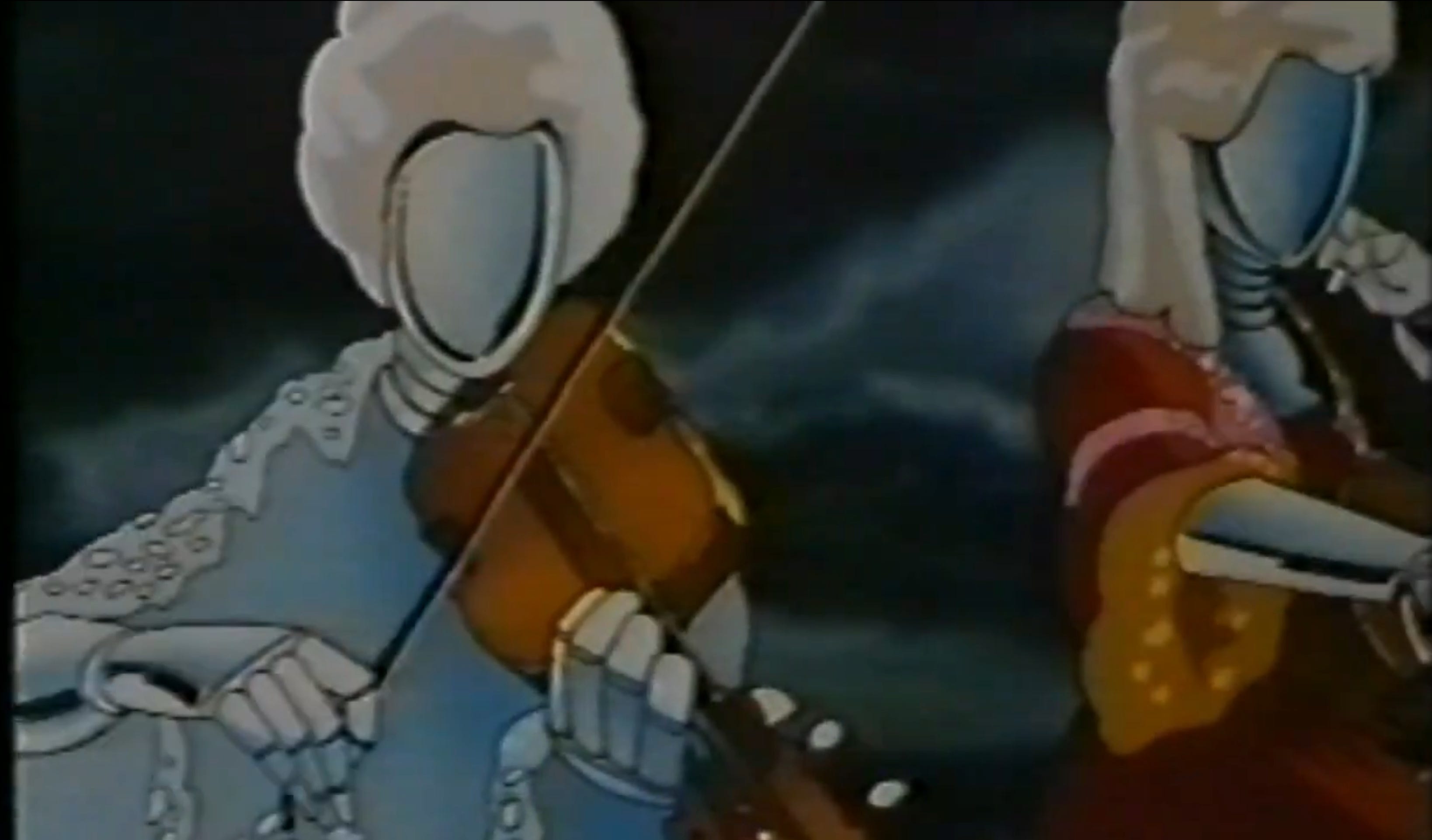
For the music video of the 1981 single “La Serenissima,” the ruins of Venice emerge from deep waters as a space ship arrives. The waters also give way to a platform with band of automatons wearing 18th-century garbs and wielding a combination of strings and electronic instruments. Meanwhile, a gold-clad astronaut takes in the view. As the musicians play, more and more parts of the sunken city reemerge, and the astronaut decides to capture it and take it somewhere else in space, and he also retrieves the music ensemble, which then proceeds to delight the space ship and its crew.
“The double shading—rough and xeroxed yet airbrushed at the same time (somewhat like the armor on Japanese robots)—combined with continuous double-exposed “cross-screen” sparkles on the faces of the mannequins and statues, makes this an extremely innovative piece of kitsch animation,” writes Mario Verger for Rapporto Confidenziale. “These faceless, antique mannequins are simultaneously modern, even robotic; amidst violins, violas, and electric guitars, their hands (replacing Mickey Mouse’s “gloves”) now closely resemble the “robotic” fists of Mazinger and Grendizer. Meanwhile, the spaceship—with its detailed, modern, and descriptive design and its charmingly graphic, Manuli-esque astronaut on board—evokes the more “Italic” atmosphere of the previous video for La Bionda, created with a more “anamorphic” line and modern colors.
For the 1984 album Odissea Veneziana, Manuli created an overarching narration that combines sci-fi, 1980s dark fantasy (à la The Dark Cauldron, Legend), Moebius, and alternate history. The protagonist looks like a cross between Wart from A Sword in the Stone and what would be Link from Legend of Zelda. This is Manuli’s treatment, transcribed by Rapporto Confidenziale from the memoir of illustrator (and frequent collaborator) Victor Togliani.
“A blond boy arrives on a rocky cliff astride a weird giant bird. On top of this menhir-like structure stands a city that looks like Venice, minus the water. The boy walks around its houses and goes through a doorway, and finds himself within the walls of an ancient palazzo, surrounded by reptiles. He kills some with his sword, then manages to get away by grabbing onto a chandelier and, after breaking through a stained-glass window, he happens upon an environment bordering the mystical, like the dome of a great basilica. In the middle of it is an enormous music box with life-sized sculptures, dressed like 18th-century musicians. The boy winds it up and the statues start moving and playing instruments. From the window in the frame we can see that a solar eclipse is taking place. Sinkholes start opening up on the ground, and from them a great amount of water erupts, which soon starts covering the cliff and rock formation, leaving the city surrounded (and not submerged) by water. Venice has risen again! As the music concludes, the boy takes off astride his bird.”
For “Casanova” (1985), the setting is more markedly steampunk and inspired by The Roses of Versailles as the famed womanizer stands trial and hops around the lagoon from bed to bed in alternate-history-like means of transportation. At this point, the band completely shed its robotic and automaton-like appearance. Remember that, in the video for “Serenissima”, they did not even have facial features, but just a smooth, metallic surface.
While Manuli has been extremely prolific, for the sake of the topics of Italian Disco Stories we would love to highlight that he also co-wrote Allegro non troppo, a 1976 mixed-media film directed by Bruno Bozzetto that was intended as a parody of Disney’s Fantasia— going as far as having an introductory segment featuring a live orchestra and an animator chained to his toolbox and materials, in order for him to live-animate as the music plays along.
Manuli, in particular, authored the Firebird segment, which starts from the Biblical creation myth and then has the devil create a consumeristic and hedonistic frenzy. Adam and Eve are portrayed, respectively, as a husky body builder and a bombshell. They leave the apple to the sly, sidekick-like serpent, while the devil looks more like a grumpy fat cat than a menacing entity. The monsters and the trials of hell are fancy cars who morph into a dragon, a multi-screen room screening peep shows, electronic appliances and pre-packaged food. For the serpent, the deepest punishment from hell comes in the form of a suit, perhaps as a jab against corporate culture. A character similar to the cosmic siren of “I wanna be your lover,” also makes an appearance, but she is a more overtly sexual temptress than her deep-space counterpart.
On the sci-fi crossover front, he also directed Fantabiblical, where the bible meets space opera and where an astronaut re-enacts the miracles of Jesus via remote control, and the mixed-media short Striptease, where the strip-tease act of a live woman is cheered on by an audience of small cartoon men.
There is an extra animated video he did for Baby Records, namely “Hypnotized” by Pink Project. It’s nowhere near readily available, though, but if you readers happened to have seen it in the wild, point us towards the assets.


