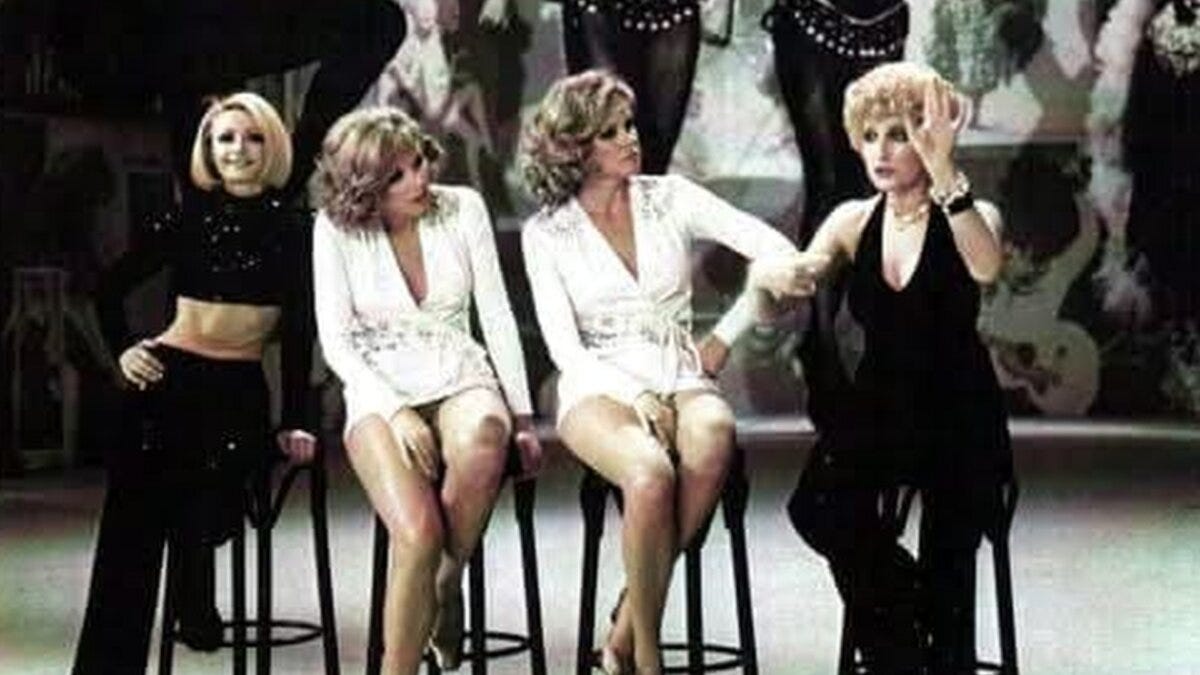
Italian Variety Shows Part 1: From Canzonissima to Stryx
We examine the theme songs, the innovations, and the leading players of this entertainment format.
A large part of our writing about disco and synth music overlaps with extensive discussions of TV shows. For any artist seeking mainstream appeal, variety shows were the ideal soundstages. Many leading figures in Italian disco, including Raffaella Carrà and Heather Parisi, were also leading ladies of variety shows, as were singers with less of a disco background, such as Mina and Milva.
So what is a variety show? Originally a lowbrow theatrical showcase associated with the Belle Époque, a variety show typically contained song–monologue hybrids, caricatures, ballet, magician acts, illusionism, and the like. It originated in Paris in the late 18th century, but by the mid-1800s it had developed a three-part structure: part one featured clowns, light songs, and comedians; act two showcased acrobats and international acts; part three was vaudevillian.
We can trace the arrival of variété in Italy to 1891, when the Salone Margherita in Naples opened its doors. That same year, Milan’s Salone Café Concerto Morisetti opened as well, and by the first decade of the 20th century Italy had between 30 and 35 café chantants, which would later evolve into variety theaters.
When attempting to “graduate” from its lowbrow associations, the format became known as revue, which maintained a neat distinction between individual numbers (musical, dance, etc.) and was, to a certain degree, scripted. It combined variety elements with an operetta-like plot. Revue is rooted in satire and parody, with origins in France but with an early and enthusiastic adaptation in Italy.
Interestingly, the format also has ties to—or at least an affinity with—Futurism. In 1913, Filippo Tommaso Marinetti wrote a manifesto on the medium, in which he praised its rejection of naturalism in favor of paradoxical, spectacular qualities.
By the time variety fully migrated to television in postwar Italy, it had absorbed all of these influences and became one of the most powerful (and, for the most part,yet safe) engines of pop culture. What follows is a chronological overview of the most significant Italian TV variety shows, from RAI’s black-and-white era to the rise of Fininvest.
Canzonissima (1956–1975)
Perhaps the best-known early variety program among mainstream audiences, Canzonissima was broadcast by RAI from 1956 to 1975, with a break from 1963 to 1967. At the center of the show was a song competition, although there were also sketches, comedy, and dance routines. Additionally, the show was always linked to the Italian national lottery.
“After the Sanremo Festival, Canzonissima was arguably the most important music competition of the Italian calendar, and the fact that it lasted for several months allowed singers to present a wide selection of material and thus showcase many of their songs for the viewing public,” writes Rachel Haworth in her book The Many Meanings of Mina, as Mina led Canzonissima 68.
Raffaella Carrà helmed it from 1970 to 1972, where she launched the famous “Tuca Tuca” and sang the theme song “Ma che musica maestro.”
Studio Uno (1961–66)
With Studio Uno, whose earlier version was called Giardino d’Inverno, Antonello Falqui created the prototype and blueprint for variety shows in black and white. Breakout stars included the German-born Kessler twins, singer Mina, and dancer and American-born choreographer Don Lurio.
Aside from the Kessler twins and their earworm-like “Da-da-um-pa” number, Mina was the breakout star, cementing her status both as a vocalist, an emcee, and an entertainer. Her own segment, “L’uomo per me” (the man for me), saw her duet with showbiz heavyweights such as Totò, Nino Manfredi, Ugo Tognazzi, Rossano Brazzi, Amedeo Nazzari, Vittorio De Sica, Marcello Mastroianni, Enrico Maria Salerno, Peppino De Filippo, Vittorio Gassman, and Alberto Sordi.
In 2017, a fictionalized account of the making of the show aired on Rai 1 with the title “C’era una volta Studio Uno.”
Milleluci (1974)
Mina and Raffaella Carrà co-hosted this genre-defining variety show. Carrà sang the opener, “Din don dan,” while Mina sang the closing song “Non gioco più.” This was also Mina’s last stint in a hosting role, before she officially retired in 1978.
In Milleluci, each episode was devoted to a different entertainment art: radio, café chantant, revue, TV, sideshow, cabaret, musical, and then operetta, circus, and Italian musical comedy. “The programme sought to ‘shine one thousand lights’ on the best of Italian entertainment through the years, and it demonstrates a certain enthusiasm and nostalgia for how things used to be, for a simplicity of cultural forms and leisure, and for periods of apparent innocence and escapism in Italy’s past,” writes Haworth.
Di Nuovo Tante Scuse (1975–76)
Hosted by actor duo and real-life couple Sandra Mondaini and Raimondo Vianello, Di Nuovo Tante Scuse was a variety show in eight episodes. It’s a follow-up to its predecessor Tante Scuse and featured ballets, music, and comedy.
E Adesso Musica (1972–76)
Airing between 1972 and 1976, E Adesso Musica spanned classical music, musica leggera, and more contemporary genres. Giuni Russo (“Carol”) and Matia Bazar (“Stasera che sera”), two of Italy’s most artistically ambitious acts, had early performances on E Adesso Musica.
Discoring (1977–1989)
A clear homage to Top of the Pops, and written by star-maker Gianni Boncompagni, Discoring was the first youth-focused TV program, with a set reflecting the trend: a DJ booth, dim lights, and young “live” audiences. In 1977, it famously hosted the Ritchie Family. The first opening themes were “Superdance” (season 1) and “Guapa” (season 2) by Bus Connection. In its fourth season, Gepy & Gepy sang “Body to Body.”
Non Stop (1977–79)
Created by Enzo Trapani, Non Stop stood out because it lacked a real host. In fact, its full title was “Non Stop: ballata senza manovratore” (ballad without conductor), and throughout each episode, audiences were delighted by a non-interrupted, chaotic—yet cohesive—sequence of cabaret, song, and dance.
Creativity fully flourished in its second season, as color TV was finally made available to Italian households. Drive In, the main Mediaset variety show of the following decade, would largely use the Non Stop format as inspiration.
Piccolo Slam (1977–78)
Another effort toward youth culture, Piccolo Slam had a set that closely recreated a discotheque, complete with “revelers” dancing on the dancefloor. The “slam” was actually a face-off, in each episode, between five selected records.
Notable theme songs include “Toccami / Piccolo Slam” from the first season and “Go!!!” by Stefania Rotolo for season two.
Ma Che Sera (1978)
The Raffaella Carrà Show! A variety show where she MC’d, danced, sang, and introduced various comedians and guests. Highlights include Carrà singing a Beatles medley, scantily clad in a nun outfit and perched atop an apple, and the gay anthem “Luca.”
Its main theme, “Tanti Auguri,” achieved a permanent place in the Italian imaginary and pop-cultural repertoire across generations.
Stryx (1978)
Enzo Trapani did it again with experimentation. Sex, magic, and occultism were the main themes of the variety show Stryx, whose specific format would eventually inspire Fininvest mainstay Drive In.
The opening credits featured bare breasts for the first time in RAI’s history, and faux-medieval Salomés, cosmo rockers, and court-jester-like MCs performed side by side. Back then, it cost 250 million lire per episode—staggering costs.
It was national TV’s response to the lewd striptease shows shown on private TV stations, which, bizarrely, were threatening RAI’s monopoly. Censorship clipped the show’s wings, and out of the seven episodes, only six aired.
Featured artists, who performed disguised as “witches,” each with individual costuming and characteristics, include Amanda Lear, Asha Puthli, Grace Jones, Gal Costa, Patty Pravo, Mia Martini, and a young Anna Oxa. It won awards but was short-lived.
Coming up in Part 2: Tilt (1979–80), Luna Park (1979), Fantastico (1979–1991), Zim Zum Zam, Premiatissima (1982–87), Al Paradise (1983–85), and Drive In (1983–88), as Italian variety television pivots from experimentation to competition, ratings, and the aesthetics of commercial TV.