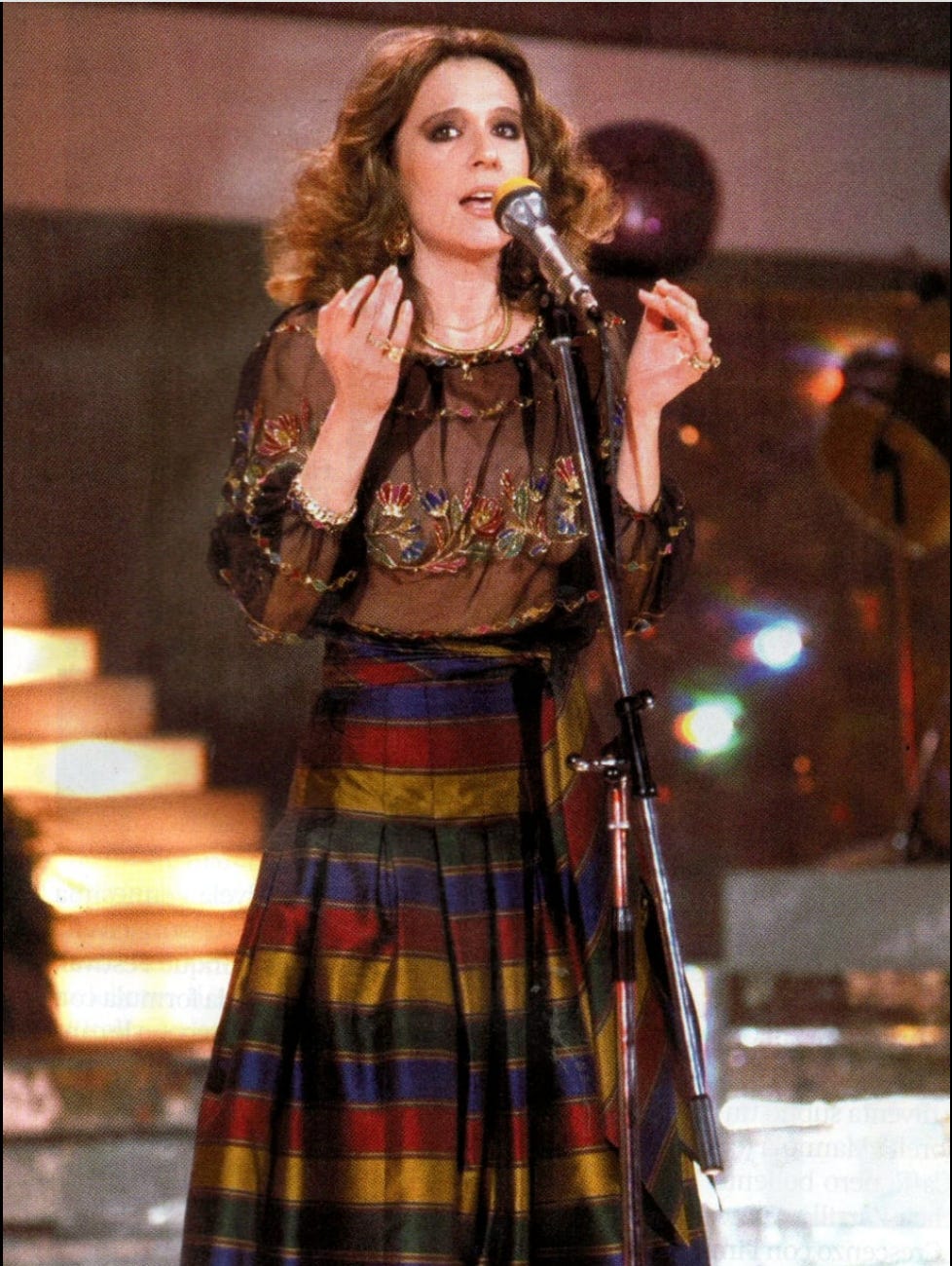
Celebrating Maledetta Primavera, the Italo Schlager That Became a Queer Anthem.
How Loretta Goggi's hit has been adopted as the ode to lost love, missed chances, and self determination
Florals for spring? Not for Loretta Goggi’s Maledetta primavera.
The song narrates a toxic relationship, where the arrival of spring is meant to portray the sensual but violent power of nature reawakening from its slumber. “What remains of an erotic dream if, upon waking, it has become a poet?” she asks herself in the second half of the first verse.
On TV, Goggi was already known as an actress and comedian, especially as an impersonator. A former child actress, she achieved her first mainstream recognition as the voice actor of Looney Tunes’ Tweety and in the 1968 Italian TV adaptation of Robert Louis Stevenson’s The Black Arrow: A Tale of the Two Roses, which had a viewership of 20 million.
Disco heads might know Goggi for her stints as a disco duo with her sister Daniela. Together, they performed disco-inflected numbers such as “Voglia,” actually the closing number of their variety show Il Ribaltone. Their song “Sto ballando,” then translated into Spanish as “Estoy bailando,” became a commercial success in Spain and Latin America, on the same wavelength as Baccara’s numbers. In 2009, Spanish drag queen duo Shimai gave Estoy bailando the dance-music treatment. As a soloist, Loretta Goggi covered Penny McLean’s “Lady Bump,” which she localized as “Ma Chi Sei.”
In 1979, Goggi had moved to the record label WEA, for whom she was recording her album Il mio prossimo amore. During one of those recording sessions, she was offered the track, penned by Paolo Cassella and Gaetano “Totò” Savio, which at that time was titled Benedetta primavera (blessed spring). Goggi herself insisted on changing benedetta into maledetta, despite the word being deemed too aggressive. The song was initially conceived as the closing number of her variety show Hello Goggi, but due to technical difficulties causing several production delays, her team decided to launch it as a proper record at the 1981 Sanremo Music Festival.
While it lost to Alice’s “Per Elisa” by a mere 30-ish votes, it remained a huge commercial success. It ended up being the eighth best-selling record of the year. Goggi’s strength as an actress might have done the heavy lifting: “The interpretation of the song became even more convincing thanks to Goggi’s acting capabilities, as she could, within the three-minute duration of the song, create a mini theatrical drama on love lost,” reports Enciclopedia di Sanremo.
The single reportedly sold 500,000 copies in West Germany and 300,000 in France, and it almost topped the Swiss charts.
What stands out is the lively, schlager-like melody that contrasts with the emotionally loaded lyrics and Goggi’s interpretation thereof. The verse requires a low register, while the refrain goes much higher by comparison, which indeed conveys the emotional release meant to contrast the somber, lovelorn lyrics.
Just like with the Chav, let’s do a Maledetta Primavera world atlas:
🇩🇪 Caterina Valente – Das kommt nie wieder
🇳🇱 Conny Vandenbos – Vrij als een vogel
🇫🇷 Hervé Vilard – Va pour l’amour libre
🇲🇽 Yuri – Maldita primavera
🇫🇮 Paula Koivuniemi – Aikuinen nainen
🇨🇿 Petra Janů – Moje malá premiéra
🇭🇷 Maja Blagdan – Zaboravi
🇧🇪 Dana Winner – Flying High
The song falls squarely in the tradition of cornerstones of Italian pop such as “Che sarà” as performed by Ricchi e Poveri, “Se mi lasci non vale” by Julio Iglesias, and “Montagne verdi” by Marcella Bella. Five years later, “Perdere l’amore” by Massimo Ranieri would strike the same chords, by virtue of Ranieri being an actor as well as a singer.
Goggi would no longer partake in the festival as a performer. She was a co-host during the 1986 edition alongside Anna Pettinelli, Sergio Mancinelli, and Mauro Micheloni of Discoring fame. On that occasion, she performed the opening number “Io nascerò,” written by Mango.
When the song turned 40 in 2021, Gay.it, Italy’s primary queer-culture online magazine, christened it as the “rainbow anthem par excellence.” Much like Shakespeare’s “Shall I Compare Thee to a Summer’s Day,” Eugenio Montale’s “Ripenso al tuo sorriso,” Marianne Rosenberg’s “Er gehört zu mir,” and many other poems and songs we’re clearly forgetting, the lyrics easily apply to any gender, and the great emotional impact of the melody and Goggi’s interpretation locates it squarely in the tradition of gay anthems like “Strong Enough,” “I Will Survive,” “Let It Go”/“Show Yourself,” and even “Golden.”
By the way—in Spain and Latin America, Estoy bailando is a queer anthem in its own right.


Si però dite anche chi erano gli autori