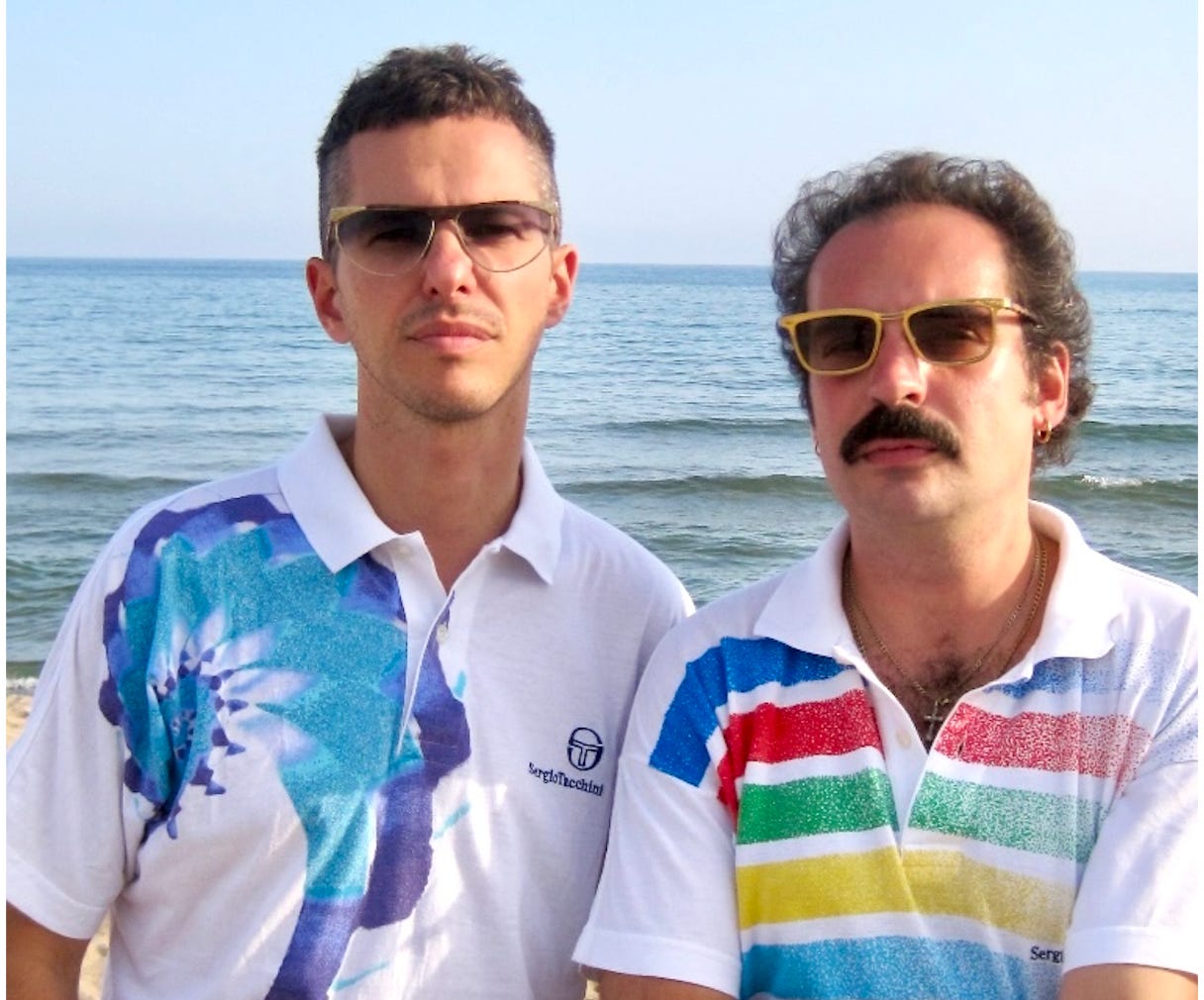
Mind Enterprises on Reinventing Italo Disco, Musical Lineage, and Their Ties to Righeira
Outtakes from their The Guardian interview
In early May, Angelica Frey profiled Andrea Tirone and Roberto Conigliaro, the neo Italo disco duo Mind Enterprises for The Guardian.
The commission was prompted by their Coachella set and by their skyrocketing fame on social media, thanks to clips of their at-home sessions going viral on platforms like X, TikTok, and Instagram, which turned them into memes symbolizing the “European way of life”, whatever that means across the political spectrum. Their press representative completely vetoed our talking about their virality and their subsequent memeification, and considering what accounts initially spread their videos, we can see why the duo barely wants to have anything to do with or say about it.
Still, over a 45’ conversation, aided by the fact that the interview was conducted by an Italian native, the topics ranged from 90s Eurodance and Italian chav culture to how to source second-hand vintage, but not without talking about the way Italian music always emphasized a strong melodic component from Monteverdi to our own Gigi D’Agostino. A healthy part of the exchange did not make it into the profile due to word-count limits. You can read the whole profile here.
We’re publishing tidbits that did not make it into the article but that deserve being documented somewhere.
On Another World, their personal favorite
“Another World is our favorite track. It’s a little darker, but it has some elements of trance music, sitting at 140 BPM. Originally, it was a pure 90s Eurodance track, with markedly Italo dance sounds but it did not work as well, so we reworked those sounds with the Jupiter synth, giving it a more 80s-into-90s vibe,” says Andrea Tirone.
On Aria sulla 4a corda and the melodic components of Italian electronic music
Their upcoming album Negroni Love features their interpretation and arrangement of Bach’s Aria on The G String, which is not available for streaming at the time of this writing.
“This connection with Baroque music is interesting to me. I’m not a musicologist, so I can’t explain it in technical terms, but I do think there’s a link there. Italo disco, first and foremost, is melody; the other elements are layered around that. If you think about it, much of Western music originated in Italy: from Monteverdi and the Baroque period, and then from there came classical music, Mozart, Beethoven, and everything that followed. Maybe it’s ultimately a cultural thing: in Italy, electronic music has always maintained a strong connection to melody, because that’s something deeply rooted in our tradition,” says Andrea Tirone. “There is a very human component in Italo disco,” reflects Conigliaro. “It emotes much more than other genres of electronic music.”
On reckoning with the 90s Eurodance
“When I think about it, the same thing happened to me. Back when I was playing guitar — around 1999 or so — Gigi D’Agostino was releasing one massive hit after another: ‘La Passion,’ ‘L’Amour Toujours,’ ‘Elisir,’ all those singles that came out during those years. And he became hugely successful. But at the time, I didn’t get it. I thought, ‘No, this stuff is cheesy, it’s not good.’ It was mainstream, while we were looking for something more alternative. In the early years of high school, I had a complete rejection of this music. Maybe because it was everywhere. And then there was the whole thing with the ‘tamarri’1 — back then they were definitely a pretty overwhelming presence. I don’t know if you remember,” says Tirone. “But looking back on it now, Gigi D’Agostino is a genius, because he created something that doesn’t really exist anywhere else. Guitar-based music, on the other hand, has been replicated everywhere because it comes from America and England, countries with enormous cultural reach. Whereas these kinds of sounds are, in a way, unique.”
Italo disco favorites
“We love Love on the Rocks by Lama. And then, speaking of a project that developed this sound more extensively, Cyber People released a series of incredibly important singles. I’d also add Kano, especially the album Another Life, which was amazing. And also Koto,” says Roberto Conigliaro.
On their vintage-apparel collection
“Many years ago, London charity shops were a goldmine for vintage sportswear, and you could get really good deals. That’s not the case anymore,” says Conigliaro. “At some point I also owned a camper, which I used to drive around the whole continent, and while on those road trips, I’d sift through local thrift stores. I raked in a lot of good stuff in France.” Conigliaro endorses sportswear brand Sergio Tacchini—especially the polo shirts and the shorts. Tirone likes Sergio Tacchini polo shirts too, but he matches them with suits rather than athletic shorts. He has been sourcing 1980s Corneliani, Loro Piana, and Cerruti. “But then I buy them and have them altered — I found a tailor who does all the modifications for me. It’s essential, because you put on a suit and you need to tone it down a bit, otherwise you risk looking too much like a bank clerk. The fact that they’re originally from the 1980s already helps remove that effect, but often you still need to soften the shoulders a little, adjust certain details, and so in the end almost all of them are reworked in some way.”
Andrea Tirone’s second-degree of separation from Righeira
“Actually, Righeira were loosely connected to my mother’s circle. They weren’t exactly friends, but they came from the same neighborhood — a small working-class town on the outskirts of Turin. You know those neighborhoods built by Fiat? My mother always told me that people used to make fun of Righeira,” says Tirone. “I think that’s something our generation didn’t really experience firsthand, but early Italo disco — bands like Righeira, for example — was seen as something awful, almost grotesque. There was this idea that it was embarrassing music, something you simply weren’t supposed to listen to.” In a way, Righeira’s “Vamos a la playa,” which endorses having fun even during a nuclear event, is in line with Mind Enterprises’ own production, whose intentional levity is meant as a respite from the heaviness of current events.
Italian Chavs, especially in their 1990s iteration.