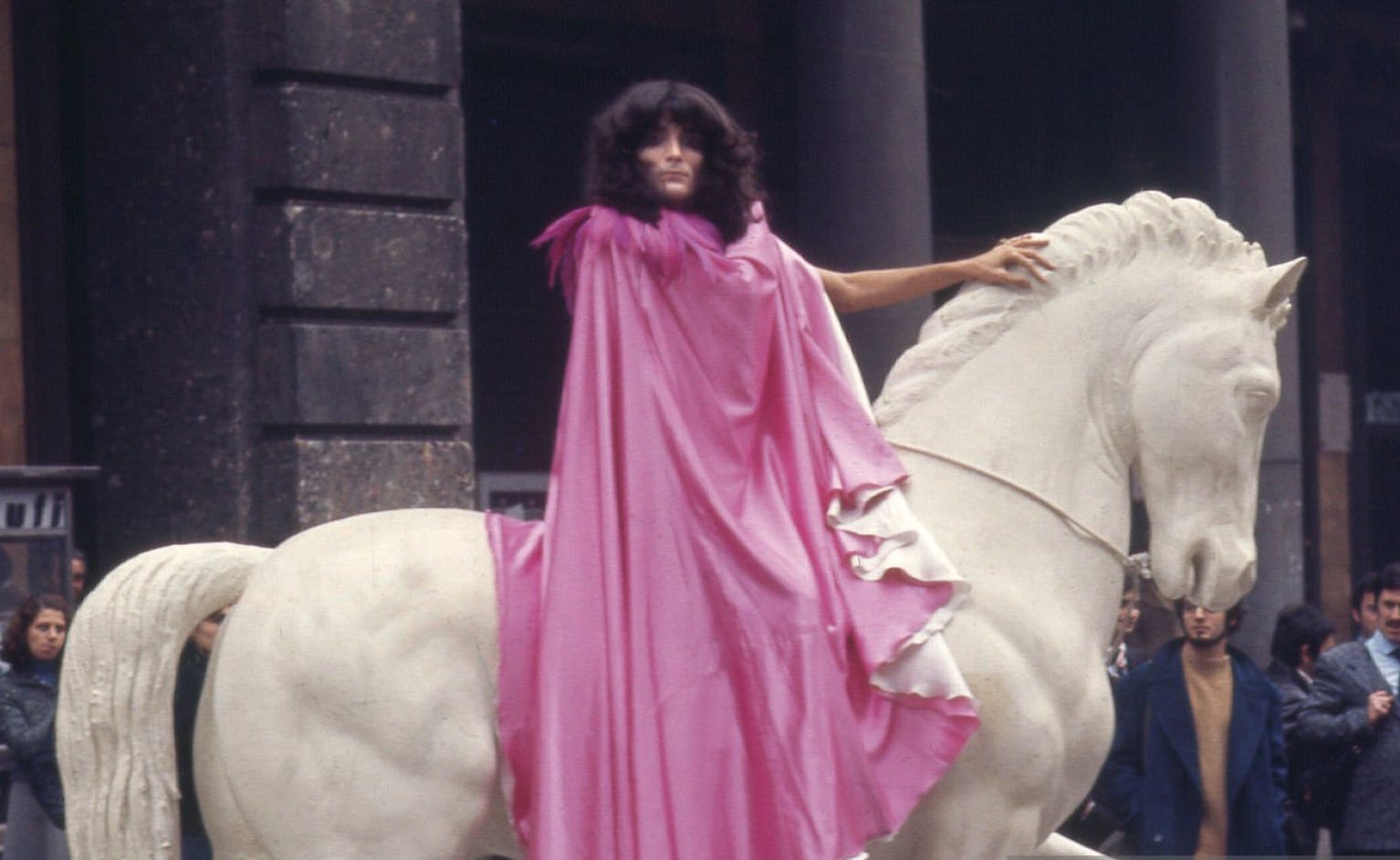
Inside Renato Zero's Musical and Visual Artistry
He drew from Commedia dell'Arte, opera, circus and Fellini. So please don't call him the Italian David Bowie.
By singing, with equal ease, about musings on threesomes, meditations on humanity as a whole, and meditations on those whom society deems outcasts—topics that were all welcome on what he called il carrozzone (his bandwagon)—Renato Zero (born Renato Fiacchini) remains one of the most, for lack of a better term, polymorphic musical artists of the Italian panorama.
Accompanied by the most flamboyant costumes and full-face makeup, his performances do blend elements of pop, theater, cabaret, varieté, and stagecraft. In fact, his artistic approach is a multidisciplinary statement in its own right, in that he started as a dancer, was shaped by cinema, bore a lifelong fascination with the circus, and dabbled, in equal measure, in pop (from ballads to uptempo songs), art pop, R&B, rock, and disco.
As for his self-presentation, he became willingly known as and ran the gamut from unabashed hedonism and childlike disposition, with monikers including “perverse polymorph” to “merchant of stars” (the celestial body, not starring performers).
Wait, doesn’t all this take place in stodgy, Catholic, and thus morally ultra-conservative Italy? “Of course, in his Catholic homeland there are also people who feel that Zero’s antics go too far, but the country’s characteristic affinity for grand spectacle—which in Italy is generally afforded respect—plays into the hands of this flamboyant bird of paradise,” author Eric Pfeil pointedly wrote in Azzurro, his love letter to Italian music from a German-language point of view.
Don’t Call Him “The Italian David Bowie”
Let’s state this at the very top: singer-songwriter Renato Zero has been treading an artistic path that only happened to be visually similar to what David Bowie, Marc Bolan, and Bryan Ferry popularized. Journalist and author Simon Reynolds famously anointed Renato Zero as the Italian representative of glam rock. Upon his official debut in 1973, Fiacchini was saddled with the burden of being compared to David Bowie and other leading players of that glam rock movement that had gotten a foothold in the UK at the beginning of the decade, first with Marc Bolan and then with Bowie. “Often, the Italian press would claim that Zero was copying Bowie, Roxy Music, and Alice Cooper [...] For Zero, the Bowie comparison has become a torture,” writes Andrea Pedrinelli in Renato Zero: Il mercante di stelle, which breaks down each album song by song.
Upon further consideration, what does Bowie even have to do with Zero? Not much. He had been crafting his looks and costumes well before Bowie achieved worldwide success. “He would not have willingly imitated him, given that Bowie did work for the parent company of his own label, who frowned upon Zero’s rise to success as they were trying to launch Bowie in Italy as well,” writes Pedrinelli. In terms of the characters and alter egos they embodied, they are vastly different as well. Bowie’s disguises went hand in hand with a precise sound aesthetic, while Zero had been tied to Italian musical stylistic conventions—and aesthetics, too. Zero’s looks reference Commedia dell’Arte, the circus, and Fellinian aesthetics.
In fact, musically, Zero came of age not only at his then-home base, the Piper Club in Rome, which championed the music of Bob Dylan, Jimi Hendrix, and Pink Floyd, among others, but also in his own household, where his father always expressed fondness for opera and melodrama. Moreover, the Fiacchinis had a family friend in the navy who would send them records directly from the US before they would officially hit the Italian market. So he was exposed to the likes of Marvin Gaye, Diana Ross, Stevie Wonder, and The Temptations, and that mix of R&B combined with pop had a strong influence on him. “But if the mania for finding the origins of unknown things in known ones were still not to subside, then a foreign name could readily—and for effect, indeed as a theatrical coup—be brought forward: Peter Gabriel. The very first Genesis performance in Italy dates back to 1972, at the Piper Club,” writes Sacha Piersanti in Zero, Nessuno e Centomila.
During his formative years, Zero was deeply influenced by Fellini’s cinema and its combination of fantasy and reality, the grotesque and the carnivalesque, and also played ensemble roles in Fellini’s Satyricon (1969) and Roma (1972).
He Made an Autobiographical Movie Between Art House and High Camp
At the zenith of his popularity, he wrote and starred in the thriller-metatheatrical autobiographical film Ciao Nì (1979), which combines live concert performances by Zero with a plot involving a death threat by someone known as Ciao Nì. Upon receiving it, Zero’s fictional self engages in a hybrid of detective work and reminiscence about his own childhood and formative years.
Memorable lines include: “I use makeup so that my own life won’t recognize me and will leave me alone” (Zero). “Nature condemned you; you wear a mark of infamy that nobody will ever erase. You’re like a rotten apple” (Zero’s fictional elementary-school teacher). “Androgynous, hermaphrodite, bisexual, heterosexual, and a little bit perverse polymorph: which one is it? You declared you believed in God; does God believe in you?” “Others tried to destroy the part of me they were afraid of” (Zero). “The truth is that you never bothered choosing my gender” (Zero to his fictional parents).
The intended killer is, it turns out, Zero’s other self, who still wants to abide by some notion of normalcy. What also stands out is Zero’s welcoming message. In one scene, he is circled by a parade of youths of all genders, heavily made up and holding roses. “They’re my creatures, too,” he says. And when considering whether or not the death threat came from a former fan, there is acceptance. “My bandwagon does not have locks, but revolving doors.”
Fun fact: despite the low-budget and shoestring production values of the whole operation, Ciao Nì reportedly outperformed Superman (1978), starring Christopher Reeve. 20 years later, a film that’s very similar in tone and aesthetic, Velvet Goldmine, would grace our movie theaters.
You can watch the whole movie on here, lo-res only, alas.
He Crafted Costumes as Masks and Vessels
His costumes are halfway between stage costumes and allegories. Clowns, Pierrot-inspired getups, and superhero-like unitards are filtered through a surrealist and Fellini-inspired lens. For his 1977 record Zerofobia, for instance, he poses for the lens of Arpad Kertesz in a total-white look, with tall, high-heeled boots paired with a bodycon tank top and leggings, but offset with a voluminous robe-like coat with an iridescent sheen. His face bears the typical clown makeup: the face is stark white, his cheeks have two red dots, while his eyes sport smoky makeup.
For the cover of the 1978 album Zerolandia, the same photographer shot him with a slightly different, more permed haircut and a jacket whose sleeves are either adorned with ribbons or tattered, while wearing a ring on each finger. On the back cover, his pose is reminiscent of David Bowie’s Pre-Raphaelite ennui on the cover of The Man Who Sold the World (1970). To convey the metaphor of his hit “Triangolo,” he wore a yellow unitard adorned with inverted triangle on his chest and his groin, and held a hollow triangle as if it were a fan or a tambourine.
For the subsequent album EroZero (1979), he is a bat-like creature with vaguely Cleopatra-inspired makeup on the front; a yellow-clad male odalisque/court jester on the back; and, in available visual assets for the album hit “Il carrozzone” (“The Bandwagon”), he appears surrounded by half-naked women and wearing a Snow Queen cape.
His 1981 double album Artide Antartide tackles the dualism he explored in Ciao Nì (1979) head-on: Artide is about everyday life, while Antartide tackles the more spiritual side. For this album, his self-presentation changed from shiny creature to something more sacred, halfway between a warrior, a paladin, and, on the back cover, a mage. In 1984, he presented the album Leoni si nasce (“Lions Are Born”) while hanging from a vine in a fur costume.
Starting in the 1990s, he shed the whole glam getup. One reason might be age; another might be artistic evolution. “I no longer need to wear makeup: I carry those crayons within me, now,” he told Vanity Fair Italia in 2023.
Here are some of his most melodically and conceptually significant songs
1. Paleobarattolo (1973)
It’s the very first track of Renato’s very first album. He was 20 years old. I feel it’s a bit of his manifesto throughout his career in the 70s and 80s. In fact the spoken intro by music journalist Eddie Ponti says it all:
When originality—or even eccentricity—is a form of talent, it becomes an alternative way of being. Consider someone who has spent twenty years—twenty years of his own life, and three thousand centuries of ours as a human race—trapped in a jar: the jar of conformity imposed by so-called civilization. Eventually, he grows weary, breaks the jar, and decides to live exactly as he wishes, true to his own nature. It is a truth that eludes almost the entire human race.
No one has the courage to be who they truly are.
Yet some artists do—a rare few who truly live out their art, their poetry, and their music—and Renato Zero is one such artist.»
2. Madame (1976)
It’s Zero the storytelling at his best - telling stories so beautifully, where sadness dissolves into musical poetry and innovation. The song explores the themes of diversity, self-love and the tension between the internal and external. Many have speculated that the “madame” Zero talks about is a transexual prostitute with a strong sensual allure but quite “strong” visual features.
3. Morire Qui (1977)
An ode to resilience and assertion of one’s own uniqueness and identity. It was released as a B-side of the single “Mi Vendo” - it makes Zero’s flirting with disco music.
4. Sesso O Esse (1978)
Continuing on the disco wave, Sesso O Esse is a reflection on the aesthetics and mechanics of sex that, with disco culture, becomes one of the key elements of contemporary culture. Zero’s approach is sarcastic and ambiguous .
5. Fermo Posta (1979)
Zero emerges as a sharp observer of darkness and repression, portraying human dysfunction without moral judgment but with empathy. In “Fermo Posta,” the disturbing antihero- a voyeuristic man trapped in sexual obsession, loneliness, and social marginality - becomes a symbol of what mental and sexual repression can produce, especially in a hopeless suburban landscape. Yet Zero suggests that those labeled as “sick” may be the very ones capable of overturning society’s false values, exposing respectability as a cage and imagining a freer, more honest world.
6. Santa Giovanna (1980)
A funk little number where Zero celebrates womanhood with all the joys and pains that come with it.
7. La fregata (1982)
“La fregata” stands as Renato Zero’s last true hit of the 1980s period: a disco-dance provocation that turns military machismo into grotesque camp satire. Playing on the double meaning of fregata, Zero stages his own twisted “In the Navy,” where the figure entertaining a ship full of soldiers is not a woman but a transvestite, exposing the hypocrisy behind nationalist and macho rituals. What might have looked like a flirtation with the establishment—especially after its appearance on Fantastico ’83—was in fact a radically subversive act: Zero brought marginal, queer, and anti-respectability discourse into prime-time television in a deeply conservative Italy.
8. Navigare (1983)
One of the 4 tracks featured in his q-disc “Calore” - its a beautiful ballad where Zero compares living life to a journey over the sea.
9. Infiniti Treni (1985)
This is the track that perhaps gets as close as it gets to the italo disco sounds coming out of Italy in those years. In, fact it is one of the few that zero releases as a 12” disco mix for potential play in discotheques and radios.


I love being taken on a journey through repertoire I didn’t know, or had never even heard of. Renato Zero had some great songs. And I’m always surprised by how much the (Euro)disco sound permeated Italian music of that era. Yet it rarely sounded silly, as it sometimes did in other European countries, Belgium included. The productions almost always sounded sophisticated and properly crafted.
My favourite is Infiniti Treni. It has that unmistakable Matia Bazar atmosphere, elegant, slightly melancholic and effortlessly stylish. Thanks for sharing!