

From "Dirty Talk" to Fantaghirò’s “Mio Nemico”: Spotlight on Rossana Casale
When Italo Disco Met Sword and Sorcery

It’s almost holiday time in Italy, which means that at least two generations will tune in at unlikely hours to watch the 1991-1996 miniseries Fantaghirò, which airs whenever there’s an available time slot on Mediaset channels. Luckily, it’s available on Mediaset Infinity in Italy and on other platforms of varying degrees of legitimacy worldwide (it was on Eternal TV for some time).
When director Lamberto Bava was getting his sword-and-sorcery miniseries Fantaghirò ready to debut for the 1991 Holiday season, he was envisioning a soundtrack that would match its mood: he wanted a crossover between classical and folk music to convey the pagan and medieval atmospheres. “One night, as I was watching TV, I saw Amedeo Minghi perform,” Bava wrote in his autobiography Il Maestro del Terrore. “It was his moment, and I was told to just forget about it: he was too busy and would never make time for us.”
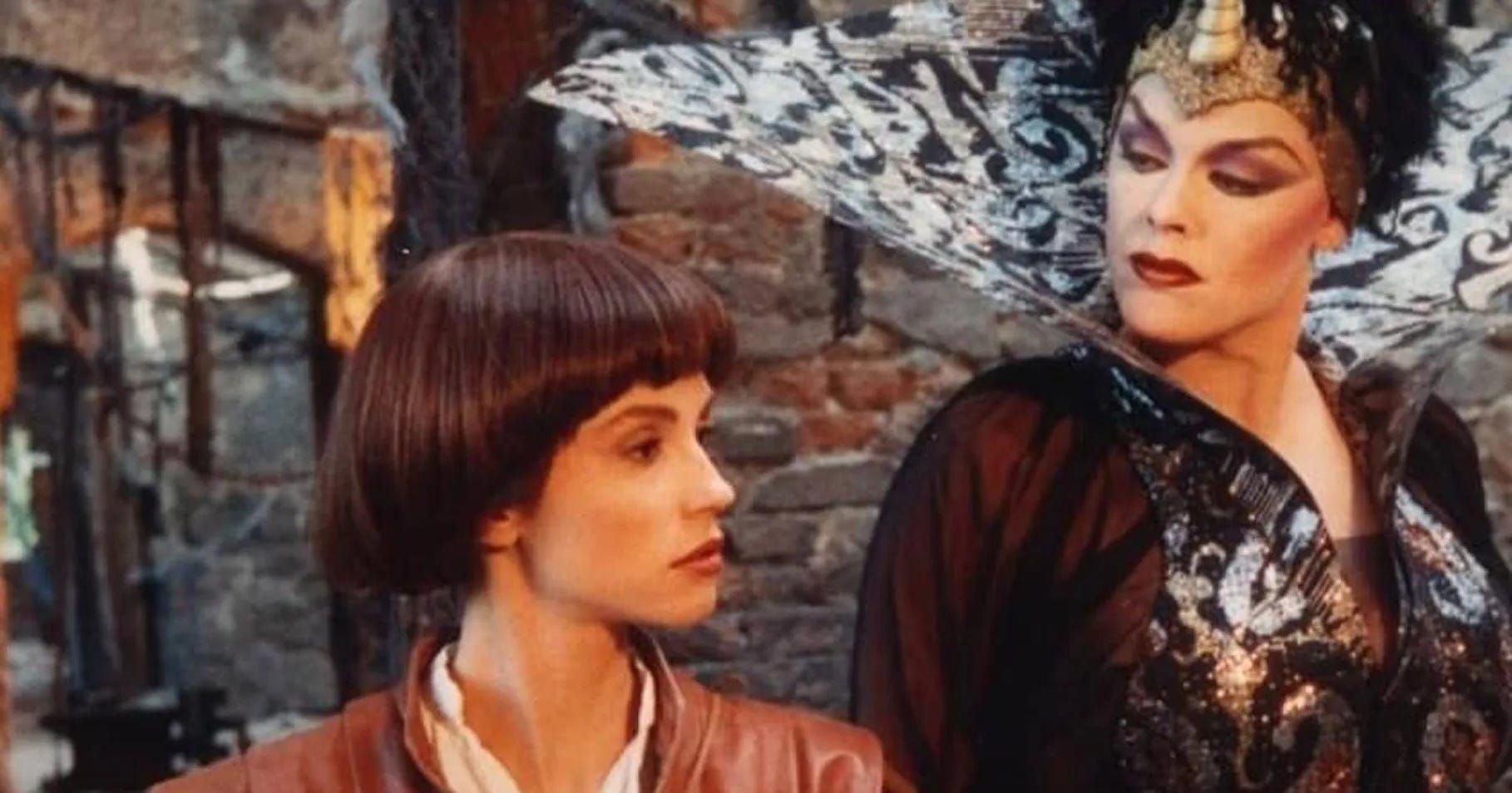
Bava did not relent, and somehow obtained Minghi’s phone number and called him. That call determined that, while being flattered, Minghi just did not have the time. Again, Bava did not give up, and just sent Minghi the script. After two weeks of radio silence, where the rest of the production team was getting antsy because the show still did not have any music, Minghi rang Bava and told him to just stop by his studio. “He was struck by Fantaghirò’s magic as well: now Fantaghirò had images, a heart, and a soul, and could finally embark on her quest.” Each of the five film-length episodes see princess Fantaghirò, played by Alessandra Martines, as the main heroine, with male leads such as Romualdo (Kim Rossi Stuart) and foe-to-foil Tarabas (Nicholas Rogers) barely keeping up with her. Bombshells Ursula Andress and Brigitte Nielsen played the villains.
The highlight is the theme song “Mio Nemico,” which is written in such a way that the lyrics are made to resemble some mock-medieval Italian dialect (despite their being in standardized Italian).
This effect is rendered through Rossana Casale’s vocalizing and artful rendition of the vowel sounds: the opening, where Casale sings “Chi amo, ed ama me” sounds like one arcane word, and it fully contributes to the worldbuilding of Bava’s fantasy world. The song recreates the “enemies to lovers” trope, which is an overarching plotline throughout the series, especially because Romualdo is an enemy in the first arc, then gets his memory wiped in the second, thus becoming a minion of the main villain; in the third and fourth installments, he gets petrified and then turned into a Gollum-like creature, and she is always the one who saves the day.
What’s interesting in this song is that the American-born Rossana Casale, who started out as a backup singer for the likes of Mina and Al Bano, between 1979 and 1984, made a name for herself in the Italo Disco Scene. She was part of projects such as Eva Eva Eva, Casanova, Bizzy & Co, Pink Project, Kano, N.O.I.A, and Miss Mystery.