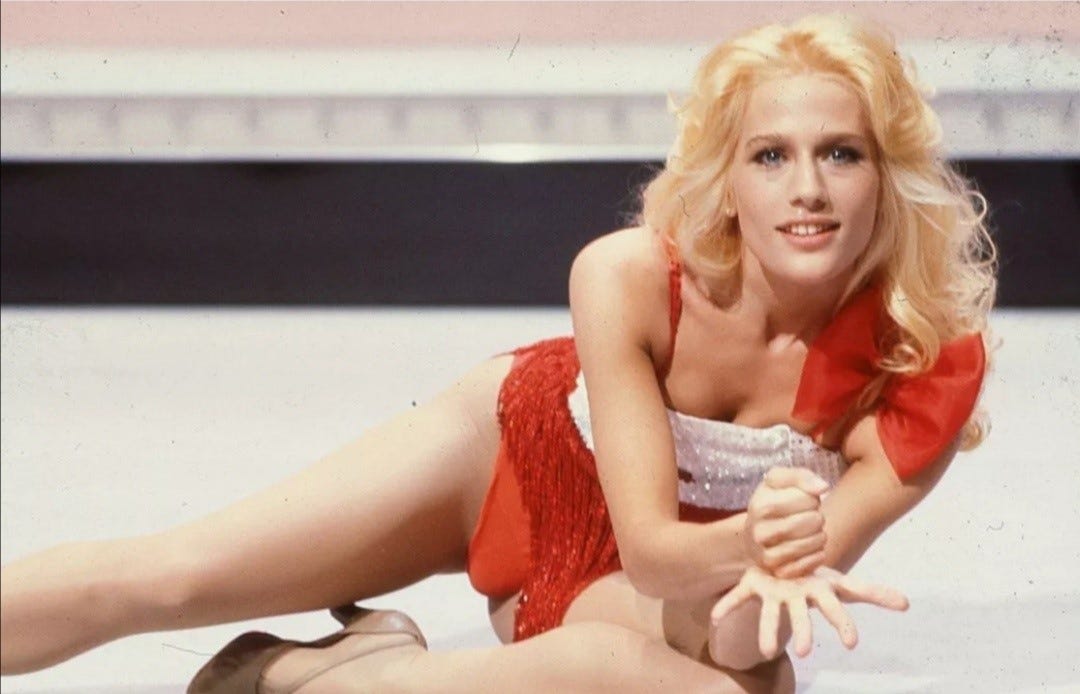
Italian Variety Shows: The 1980s, Loud and Wondrous
Enter the rise of Fininvest and color TV as a toolkit of endless possibilities
At the dawn of the 1980s, two main players helped ramp up the form and content of variety shows. One was the rise of Fininvest, Silvio Berlusconi’s network that was unabashedly commercial and had a keen eye on the culture and aesthetics of the United States of America and was less bound to the decorum of RAI. The other was, of course, color broadcast, which only arrived in Italy in 1978 and enabled more sophisticated and/or artistically ambitious and/or immersive sets and costumes, which, in turn, meant even more stellar music numbers, both original and covers. We got an inkling of it with Stryx in 1978, but the eighties saw sets that recreated discotheques, abstract halls of mirrors, enchanted fairy-tale landscapes, circus and revue theater halls, cruise ships, beauty centers, and drive-in movie theaters. In case you missed it, read Part I here.
At the heart of 80s television was also the attempt to find someone as impactful as Raffaella Carrà, who was aging out of her “showgirl” persona and fully transitioning into the “grand dame” of Italian entertainment, gradually trading catsuits and high kicks for regal gowns and power suits.
Shows mentioned include:
Fantastico (1979–1991)
Tilt (1979–1980)
Luna Park (1979)
C’era due volte (1980)
Zim Zum Zam (1981–1983)
Premiatissima (1982–1987)
Al Paradise (1983–1985)
Drive In (1983–1989)
Beauty Center Show (1983)
Risatissima (1984–1985)
Fantastico (1979–1991)
Combining county-fair, disco, opera house, and clubby atmospheres, Fantastico was an Italian variety show that aired from 1979 until 1991. The first season had up to 23.6 million viewers.
It’s notable for its first-season opening theme, “Disco Bambina,” performed by American-born soubrette Heather Parisi. The second season (1981) still featured Parisi, this time performing “Cicale,” alongside ballerina Oriella Dorella.
For the third season (1982), Raffaella Carrà became the host and sang the opening theme “Ballo Ballo.” Disco star Renato Zero had his own segment (Fantastico Zero), with its own theme, “Viva la Rai.”
Parisi returned the following year with the opener “Ceralacca.” Unfortunately, Fininvest put a wrench in Fantastico’s hegemony with its own Premiatissima, so in 1985 Fantastico changed format and became a live show, turning into a song contest.
Tilt (1979–80)
This show only ran for one season and was the springboard for host Stefania Rotolo, who was primed to be an entertainer in the style and caliber of Raffaella Carrà but who prematurely passed away in 1981.
It was set inside a fictional disco and had three standout themes: opening theme “Disco Tic,” closing theme “Cocktail d’amore,” and “Marameo,” which announced the child-friendly segment within each episode.
Luna Park (1979)
Luna Park was an Italian variety show airing for one season only, from March 24 to May 19, 1979. Given its name, the set design closely resembled a carnival.
Throughout its eight episodes, a host of comedians performed side by side with multi-hyphenate Heather Parisi, in her Italian TV debut, and Tina Turner, who became a fixture on the show at a time when her U.S. music career was in a lull. The opening theme was a markedly disco track by New Trolls, titled “Anche Noi.”
C’era due volte (1980)
Enzo Trapani continued his fascination with folklore and fairy tales already seen in Stryx with his follow-up effort C’era due volte, where he stayed true to his provocateur persona and chose Ilona Staller as a host. Throughout the show, Staller added twists and turns to traditional fairy tales, and performers such as Peter Tosh, Demis Roussos, and Amadeo provided song-and-dance numbers. Pino Presti composed the original score.
Zim Zum Zam (1981–83)
Magician Alexander hosted this peculiar show combining magic tricks, music, and dance numbers. Its first edition featured the likes of Kate Bush, Marcella Bella, Viola Valentino, Donatella Rettore, and Alice.
Premiatissima (1982–87)
The first variety show of the newly minted Canale 5, Premiatissima was Fininvest’s answer to Fantastico. Structurally, it hinged on a music-contest format, with six teams competing tournament-style. It was, in a way, a homage to Canzonissima.
The set design is worth describing: the space was decked in mirrors, both on the floor and walls, while over the stage towered the quadro della moda, a rectangular contraption with neon lights. Music numbers were filmed in chroma key and then processed on computer, with subsequent editions featuring additional mirrors.
It started with low ratings (around 2 million viewers, climbing to 9 million by the end of the first season). Amanda Lear was co-host of seasons one and two, and she also sang the closing songs, respectively “Incredibilmente Donna” and “No Regrets.” Trippy performances include Patty Pravo’s “Zorba” and Iva Zanicchi singing Cher’s “Bang Bang.”
A highlight of the show was Patty Pravo’s run in late 1984. On those occasions, she reinterpreted 20th-century standards including Il terzo uomo, Mille lire al mese, Come le rose, La danza di Zorba (three performances), Che m’è ’mparato a fa’, and Il negro Zumbon, creating immersive performances where costumes were both futuristic and mythological.
Al Paradise (1983–85)
Created by Antonello Falqui and Michele Guardì, this variety show stood out for its elaborate circus-like setting and premise. In its first season, singer and Brecht interpreter Milva paired with American-born showgirl Heather Parisi to take each episode through one comedic segment, one guest appearance, and one variété segment, each inspired by a different city or era—Paris, London, Hollywood, Madrid, Brazil, the Belle Époque, interwar Berlin, Vienna, Broadway, and Italy.
The opening song was “Radiostelle” by Parisi; the closing number was “Cantare e vai” by Milva. The following year repeated the diva-plus-younger-showgirl setup, rotating it through episodes. The closing number was “Tutti clowns” by Academia’s Sound.
The final season created a satire/parody hybrid centered on Alessandro Manzoni’s The Betrothed, with Al Bano and Romina Power starring as the title characters and references to current events, pop culture, gossip, and show business. The main theme was “Sky” by Italian-American showgirl Bonnie Bianco.
Drive In (1983–89)
Drive In takes its name from its setting, which recreated the appearance of drive-in and drive-through restaurants such as Sonic. Initially, writer and showrunner Antonio Ricci wanted it to be solely comedy-focused, to differentiate it from the variety shows of years past, but he eventually created a hybrid of sketch comedy, sitcom (the “frame story” follows the owners of the titular business searching for escapism), and song-and-dance numbers.
On top of all that was the addition of an ensemble of showgirls known as the ragazze fast food, who served customers while wearing barely-there costumes, anticipating what was to come in the following decades.
The format was all fast-paced action and no filler, which heavily influenced other areas of entertainment and performing arts. While the satire component was welcomed, critics saw in Drive In a desperate attempt by Italians to emulate American hedonism.
Beauty Center Show (1983)
The setting for Beauty Center Show is a beauty and wellness center, inspired by the wellness and fitness craze that was beginning to percolate in Italy.
Comedians Franco Franchi and Ciccio Ingrassia host alongside showgirl Barbara Bouchet, who sings the opening song “Se tu fossi bello.” Music and show-business guests include Iva Zanicchi, Marcella, Carmen Russo, Ricchi e Poveri, Amanda Lear, and Lory Del Santo.
Risatissima (1984–85)
While the name echoes Premiatissima, Risatissima is less centered on music than on comedy and gags. What stands out is the show’s set, which recreates a cruise ship, and Ornella Vanoni, who performs one song in each episode. The host is Milly Carlucci, whom costume designers were trying to turn into a modern-day Rita Hayworth due to the uncanny resemblance.
If there is a show you want us to go deeper in, do not hesitate to tell us in the comments. The next dedicated article will feature Non è la RAI, the final boss of variety shows. It combined a vaporwave set, 1990s-do-the-1970s nostalgia, and trends that fully anticipated influencer and “hype house” culture and the parasocial relationships that arise and dance numbers that would not be out of place on TikTok.


I wish there was more ink about Fantastico. My story is this: I discovered, while living as a teenager in New York City in the 1980s, a city-owned channel, WNYC, that offered leased-time programming from different countries. RAI was a fixture every night, and on one year, there was the same-week broadcast of Fantastico, the very year that the mighty Adriano Celentano hosted. His presence dwarfed all others, but he was great in participation with cohosts Heather Parisi, comediennes Marisa Laurito, Massimo Boldi, and Maurizio Micheli. There was a band that played serious uptempo 50's rock that was right up Adriano's alley. I remember the seemingly random array of performers and presenters, and some ties to the National Lottery. I know precious little Italian, and with no translator nearby (this was 1987, after all), I could only marvel at what I was seeing. Hard to find full episodes online but they are out there, and very entertaining. It's the reason I followed this Substack.