Italy at Eurovision: 1983-1990
Apologies in advance: no Italo disco entries to be found.
Make sure you catch up with the disco years
As Eurovision entered the 1980s and into 1990, we can clearly see a clear display of emotional maximalism: artists like Anna Oxa and Fausto Leali brought a level of theatrical intensity to the stage, in line with past genre-defining schlager entries like “Ein bisschen Frieden” (which won in 1982) and Céline Dion’s own “Ne partez pas sans moi” (which won in 1988). And speaking of Nicole’s plea for “A Little Peace,” that anthem actually set the stage for the political and hopeful themes seen later in Toto Cutugno’s “Insieme: 1992.” It was a soft-rock and gospel-influenced ballad that is as cheesy as it is fist-pump-in-the-air worthy.
Also, Despite the dominance of Eurodisco and Italo disco in the European imagery of Italy, Italy’s 1980s entries during this time, such as “Magic oh Magic” and “Insieme: 1992,” have a strong “anthemic pop” component. The chosen songs often featured mid-tempo verses that exploded into massive, communal choruses, in line with the trends in synth-pop and power ballads alike. The lyrics might be in a foreign language, but the melody and rhythm are fairly universally understood.
1983: Per Lucia
Artist: Riccardo Fogli
Riccardo Fogli was once the frontman and the bass player for the Italian rock band Pooh, but he later left his rock roots to embrace a more refined, restrained, and conservative sound. “Per Lucia” may have been the 1983 entry to the Eurovision Song Contest, but it possesses the throwback sound of a late 1950s or early 1960s piece of musica leggera, thanks to its gentle piano-led arrangement, its restrained orchestration, and a very “spoken” melodic line. The oom-pah rhythm gives it a hint of varieté and cabaret vibes. To the readers of Italian Disco Stories, it might be of interest that Fogli was married to Viola Valentino (of “Comprami” fame) and then abandoned her for a two-year period for a liaison with Patty Pravo. This song placed 11th place.
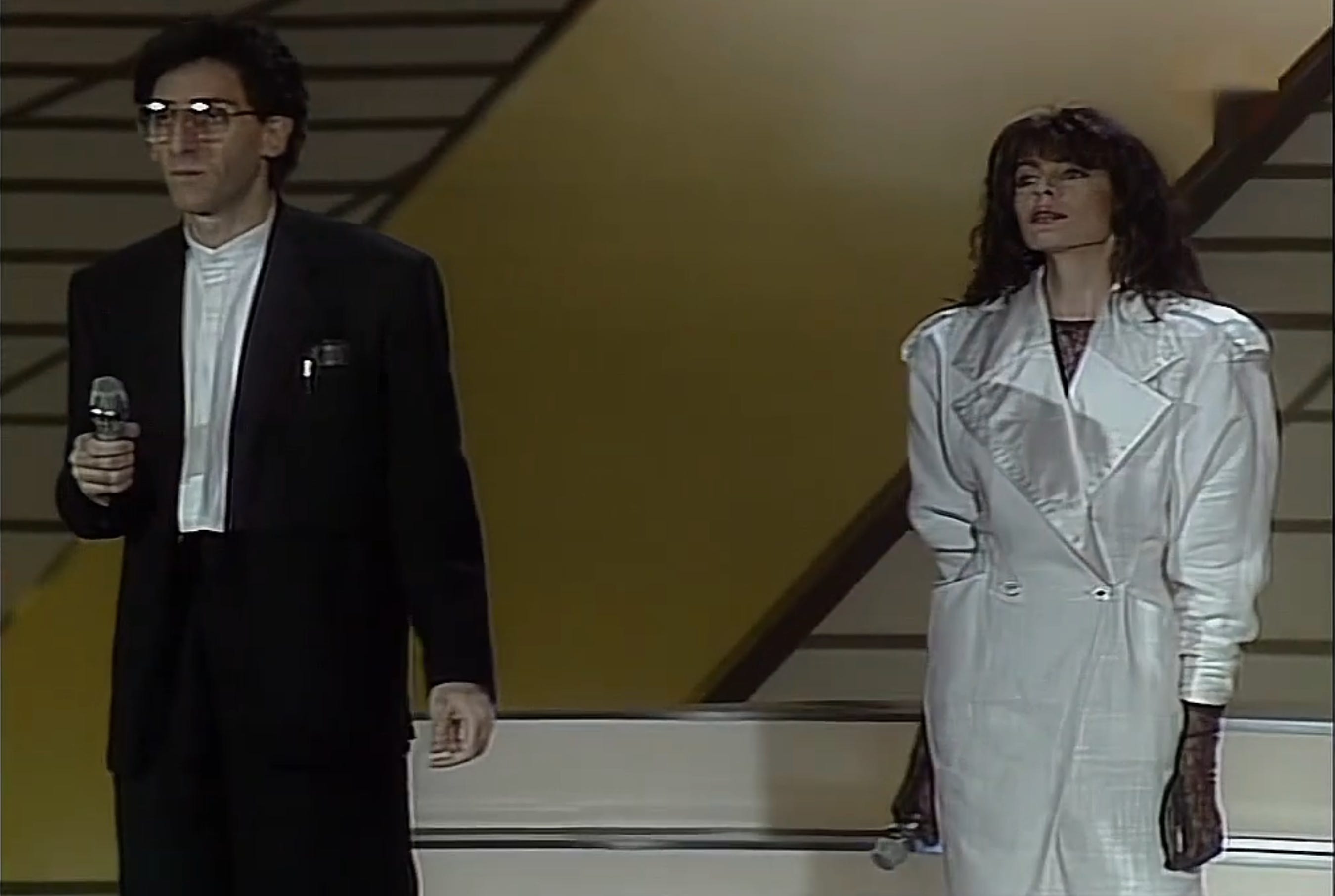
1984: I treni di Tozeur
Artists: Alice & Franco Battiato
Tozeur is a desert-oasis town in Tunisia surrounded by a saltwater lake where desert mirages occur frequently. This setting is unsurprising given Franco Battiato and Giusto Pio’s penchant for exotic imagery, as seen in their work for Sibilla and Giuni Russo. For this duet with Alice, however, the melody and rhythm are markedly more mainstream-audience friendly. While there are still highbrow references—such as the philosophy of Georges Gurdjieff in the line “e un ricordo di me come un incantesimo” and the operatic choir in the outro singing a snippet from Mozart’s The Magic Flute—it otherwise has all the markings of a song that serenades a road trip. It is a sophisticated entry by Eurovision standards, but very much entry-level in terms of Battiato and Pio’s music universe. That same year, Alice also duetted with Stefan Waggershausen on the song “Zu Nah am Feuer.” This song placed 5th place.
1985: Magic Oh Magic
Artists: Al Bano & Romina Power
Nine years after their first Eurovision appearance, Al Bano and Romina make another appearance. With its opening by backup singers, “Magic Oh Magic” almost sounds like the opening theme of a motivational Saturday-morning cartoon. Much like “I treni di Tozeur” and “Gente di mare,” it has that wholesome Italo-pop sound that foreigners associate with endless summer, leisure, and life-changing experiences. In a way, its combination of a mid-tempo verse and an anthemic refrain makes it the quintessential ’80s Eurovision—accessible, polished, and internationally friendly. It is by no means groundbreaking, but very effective for Italy’s own soft power at the time. This song placed 7th place.
1987: Gente di mare
Artists: Umberto Tozzi & Raf
This Umberto Tozzi/Raf duet is what can at best be described as a “bonfire song,” something that you belt out with your friends at the end of a camping trip or a momentous summer vacation where you forged new friendship bonds. The verse is in a frantic recitativo, but the chorus is pure, emotional Italo-schlager. Regarding the fashion: both Raf and Umberto Tozzi wore cropped jackets (a varsity jacket and what looks like a variation of an aviator jacket) with jeans that we would now fully qualify as “skinny” but with 0% stretch. Funnily enough, both artists had one of their hits—“Gloria” for Umberto Tozzi and “Self Control” for Raf—covered by Laura Branigan, and these two songs also embody the two polar opposites of Italian pop: one is an upbeat anthem, the other an example of that slow, almost chilly synth-pop/Italo-disco hybrid. This song placed 3rd place.
1988: Vivo (Ti scrivo)
Artist: Luca Barbarossa
In “Scusa se ti scrivo” (Sorry for writing to you), Luca Barbarossa plays the role of a lovelorn ex who apologizes to his former flame for writing to them. In the song, he explains that he had resorted to the medium of writing because sometimes spoken words are not enough. Answering machines are not good either, as you can just delete a message. All that he has from that love story is an old photo of his former lover, whose piercing gaze in the photo makes him feel alive. He is not too despondent, though: “I live, live, live without you, and I’ll find a reason to keep on living,” he sings. Worry not! The base combines synths and guitar, turning the singer-songwriter style of Barbarossa into a classed-up version of a soft-rock anthem that has the potential to work in an international context. This song placed 12th place.
1989: Avrei voluto
Artists: Anna Oxa & Fausto Leali
In 1989, Anna Oxa and Fausto Leali won the Sanremo music festival with the heart-rending power ballad “Ti lascerò,” which is emotionally charged and dramatic to the point where it makes, say, Cats’ “Memory” sound like upbeat Kidz Bop. For Eurovision, they presented “Avrei voluto” (I would have wanted), which is on the tamer side until the drums kick in and Fausto Leali screams, “I would have wanted to tie you up just so I could watch you every day,” with Anna Oxa engaging in this exchange about relationship regrets as a full-blown belter. In a way, “Ti lascerò,” which can be translated either as “I will leave you” or “I will let you,” talks about the intent to let the other person go, while “Avrei voluto” is about the regrets following the separation. The closest contemporary comparison to this high-drama duet is “Brividi,” sung by Mahmood and Blanco. This song placed 9th place.
1990: Insieme: 1992
Artist: Toto Cutugno
With gospel-like opening bars sung by five backup singers, Toto Cutugno performs the verses of the song almost as if they were a prayer, between solemnity and hope. The instruments progressively swelling, however, smoothly lead us into the chorus, which combines the anthemic characteristics of 1980s Italo-pop with gospel-like elements. One can’t even scoff at the worship-music-bordering structure of the song, though, as it’s about the hope for uniting Europe at the tail end of the Cold War and the upcoming fall of the Soviet Union… “under the same sky” and thanks to “an Italian song for you.” The “1992” part of the title refers to the projected year in which the European Union was set to begin its operations. This song placed 1st place.