Understanding Raffaella Carrà’s Love of Musical Theater
Five years after the entertainer’s death, a look into her own tributes to musical theater, from The West End to Broadway
This article is free because of the stature of Raffa.
Across cultures, we celebrate Raffaella Carrà as an all-around singer, dancer, and performer who put Italian pop culture on the global map; who could equally entice housewives, children, and queer audiences; and who put as much emphasis on the visual component as on the musical/performing component of her art.
Here, we covered her music and the costume designs she favored. Yet, five years after her death, we would be remiss in our duties as Italian-performing-arts cultural ambassadors (and makers, in the case of Beppe) if we did not analyze her love for musical theater—an art form that has permeated both her stage and TV performances over the decades, both via stylistic cues and direct tributes.
An important thing to remember is that Carrà was, first and foremost, a stage performer. She had professional and academic training both in dance and acting, and only included singing as an add-on, so it should come as no surprise at all that her musical-theater-inspired numbers include full-fledged choreographies.
Consider “Ma che musica maestro,” the opening theme of the varieté show Canzonissima 70, which would also serve as Carrà’s own debut single.
The entirety of the performance takes cues from Hollywood musical comedies, and Raffaella doesn’t sing as much as she performs and interacts with the corps, in a combination of front-facing and bird’s-eye-view cinematic shots. The song itself is very meta: in it, Raffaella sings about an invitation to dancing and singing for a celebration thrown in their own in-universe honor, eventually praising the melodic line invented for that exact purpose. The fanfare-like instrumental base is, blatantly, more stage-play- or parade-friendly than radio-play-adjacent.
Gisa Geert, the choreographer, had cut her teeth with revue theater and musical comedies, and she was known for the artful sets she deployed for her choreographies. For Totò’s “Bada che ti mangio,” she deployed a life-size chessboard, with the dancers playing two opposing sets of pawns (in that case, Capital vs. Labor), and, for the finale, a musical fountain shooting up 15-foot-tall jets. Keep that name bookmarked, as she would choreograph the debut season of Fantastico as well.
When it came time for her to co-host Milleluci with Mina in 1974, the direction mandated that each episode be devoted to a different performing art: Radio, Café Chantant, Revue, TV, Avanspettacolo, Cabaret, Musical, and Operetta + Circus + Commedia musicale.
So, for the episode devoted to musical theater, under the choreography of Gino Landi, Mina and Raffaella Carrà performed some of the best-known pieces of the musical repertoire, not in the style of a medley, but as individual performances. “Top Hat,” from the eponymous musical, has both of them perform in sync, only to then have Carrà perform a virtuosic tap-dance number. In the Hair segment, which consists of a mash-up of “Age of Aquarius” and “Let the Sunshine In” and only features Carrà and a host of ensemble singers and dancers, she starts off clad in a caftan, only to make room for a fringed two-piece set. She has solo parts in “Age of Aquarius,” while “Let the Sunshine In,” performed under a clear plastic tarp (?), is more of an ensemble dance number. Mina’s corresponding solo number is Jesus Christ Superstar’s “Everything’s Alright.” Another notable duet is “Bye Bye Baby,” from Gentlemen Prefer Blondes, which mirrors, in performance, what Carrà and Mina did for “Top Hat.” (You can watch the entire episode on Rai Play if you’re located in Italy or resort to the janky version of Dailymotion, part 1 and 2)
She and Don Lurio engaged in a Broadway tribute in 1974 for Canzonissima and then again for La Hora de Raffaella (we chose the latter due to the availability of better-quality video). In the Spanish version, she introduces it as a “potpourri of American musical comedies,” with a strong improvisational component. She starts with “I Could Have Danced All Night,” which has a strong polka-inspired arrangement. Lurio plays a very enthused stage peer. They then proceed to duet in “Tea for Two,” from No, No, Nanette, fully showing their range, since this number requires more restraint than others. For “Singin’ in the Rain,” they engage in a game of subtle footwork, and they dance. She then swiftly transitions to the standard “Yes Sir, That’s My Baby,” and she and Lurio engage in a Charleston-inspired choreography. Their duet of Gershwin’s “I Got Rhythm” is pure zest, showcasing both Carrà’s and Lurio’s unfettered enthusiasm.
For her around-the-world show Millemilioni, she devoted an entire musical segment, filmed in London, to a medley of numbers like “There’s No Business Like Show Business,” “Hello, Dolly!,” “Steam Heat,” “Wouldn’t It Be Lovely,” “I Could Have Danced All Night,” “Aquarius – Let the Sunshine In,” “Day by Day,” “Jesus Christ Superstar,” and “I Got Rhythm.” She fully leads the performance both as a singer and a dancer, performing a full choreography with footwork and legwork. In the performance, Carrà and the dancers start off in suits complete with Breton tops, top hats, and yellow gloves, and, when “Hello, Dolly!” comes along, she is partially disrobed, with the same basic outfit but with Dolly’s parasol. For “Steam Heat,” she ditches the parasol for an oversized men’s shirt; when the My Fair Lady segment comes around, she puts on a smock that is supposed to recreate Eliza Doolittle’s demeanor, which she ditches for a feather boa for “I Could Have Danced All Night.” Again, she performs “The Age of Aquarius/Let the Sunshine In” with a jazz- and gospel-adjacent arrangement that makes the performance feel more raw and intimate. She also becomes a clown for “Day by Day.” She returns to her top-hat outfit for “I Got Rhythm.”
In 1984, for Pronto, Raffaella?, she performed a 10-minute musical segment devoted to Cats, conceived as a lengthy and virtuosic ensemble choreography with an original melody, where the ensemble makes full use of the scaffolding and props on set, true to their feline inspiration. Carrà arrives as Grizabella, regaling us with a rendition of “Memory” that shows us a vocal range we’re not fully used to when it comes to her own music. Funny enough, the song then fully transitions into the closing dance segment, and Carrà ditches Grizabella’s mournful demeanor and garb to join the other cat-like performers.
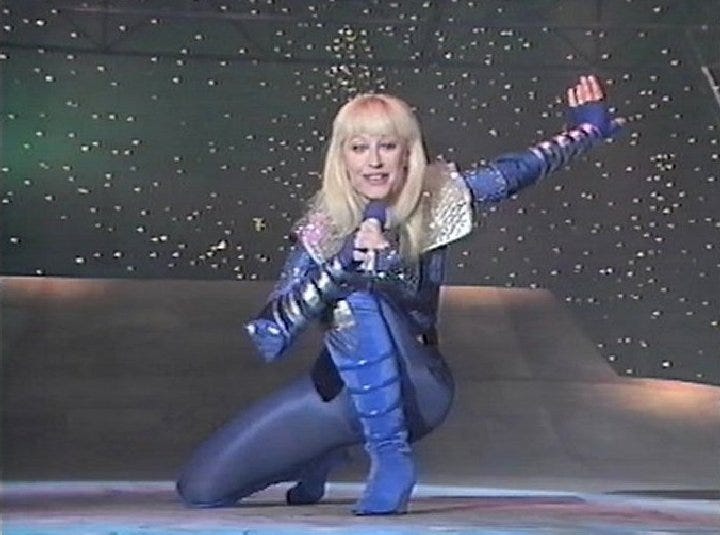
In 1985, for Buonasera Raffaella, Carrà staged an hour-long tribute to Andrew Lloyd Webber’s then-fairly-new Starlight Express across nine different performances over several episodes, with choreographies by Sergio Iapino. The costumes are fully in line with the West End original, with Carrà perfectly at ease in a cosmic-queen aesthetic. Tracks she performs as a soloist include “Rolling Stock,” where she flawlessly dances with the ensemble to the point that they all gather in a pyramid formation and Carrà ends up doing the splits at the very top, with two other dancers each holding her feet on opposite sides of the formation. In “Here Comes the Diesel Train,” she starts with a solo performance that is sensually charged, only to then erupt into a dynamic choreography with the ensemble. In the pivotal song “I Am the Starlight,” she ends up singing Rusty’s part, belting the famous lines “I am the starlight/I can achieve anything/All the things I didn’t believe I could do,” and then performs the role of Pearl in the solo “Only He,” which reprises the melody of “I Am the Starlight.” Her rendition is pretty convincing both in terms of acting and vocal command.
And while she never actually starred in a full-length musical production onstage, she became both the basis and the muse for one in the 21st century. Raffaella Il Musical is the first biographical stage musical devoted to her life and career, written by Luciano Cannito with artistic direction by Valeria Arzenton. It completed two Spanish runs in 2023 and 2025 and will soon hit Italian stages. A jukebox musical film titled Explota Explota, directed by Nacho Alvarez, uses Carrà’s songs to detail the dreams and aspirations of an aspiring dancer and her friends in post-Franco Spain and was released in 2020.


